

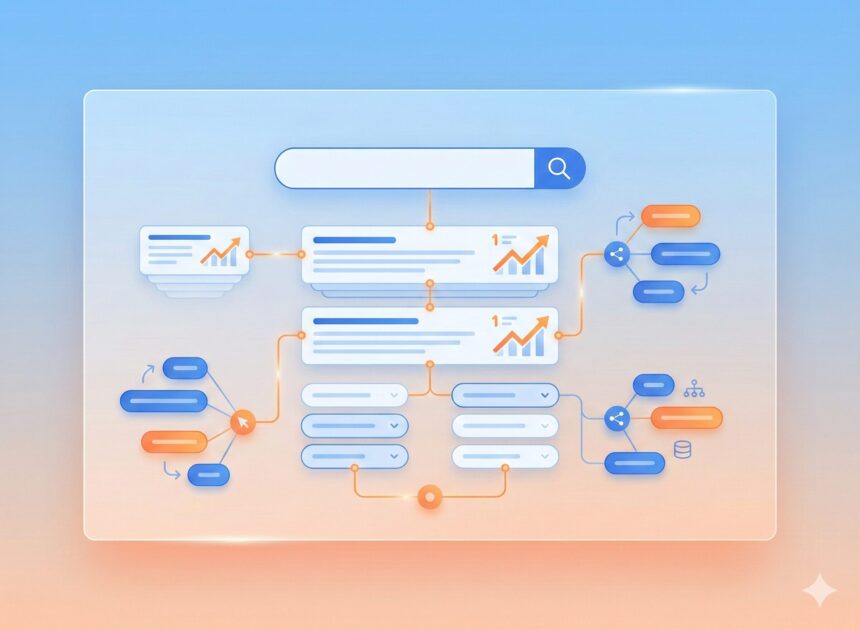
In the hyper-competitive digital landscape, appearing on Page 1 is only half the battle. To truly dominate, brands must capture topical authority and minimize pogo-sticking. One of the most potent weapons in Google’s arsenal for guiding user intent is the “People Also Search For” (PASF) feature.
For a forward-thinking agency like Revix Solutions, PASF isn’t just a SERP feature; it’s a roadmap to understanding the secondary and tertiary needs of your target audience. This guide provides an exhaustive look at how to leverage PASF to skyrocket your impressions and outmaneuver the competition.
Decoding the “People Also Search For” Phenomenon
What is PASF?
PASF is a dynamic Google Search feature that appears when a user clicks an organic result and then immediately returns to the search results page. This behavior, known as “pogo-sticking,” signals to Google that the initial result may not have fully satisfied the user’s intent.
The Mechanism of Action
Unlike the “People Also Ask” (PAA) box, which is static upon the initial search, PASF is reactive. It is triggered by user dissatisfaction or curiosity. When the “Back” button is hit, Google injects a box directly under the result the user just left, offering alternative paths to the information they likely seek.
Why PASF is the “Hidden Jackpot” for Revix Solutions
Optimizing for PASF queries allows your website to:
- Reduce Bounce Rates: By addressing PASF topics within your content, you satisfy the “Next Step” intent on-page.
- Increase Topical Authority: Covering these semantically related terms signals to Google’s BERT and Gemini models that your content is a “Complete Resource.”
- Capture Long-Tail Traffic: PASF terms are often highly specific queries that traditional keyword tools might overlook.
The Technical Side: PASF, Dwell Time, and Pogo-Sticking
Google’s primary goal is to solve the user’s problem as quickly as possible. If a user pogo-sticks from your site to a PASF suggestion, it negatively impacts your Dwell Time metrics.
Understanding the “Intent Gap”
If a user searches for “SEO Services” and the PASF box suggests “SEO packages for small business,” it reveals an intent gap. The user wasn’t just looking for services; they were looking for pricing and structure. By identifying these gaps, Revix Solutions can bridge the distance between a “Visitor” and a “Lead.”
How to Conduct Advanced PASF Keyword Research
Traditional tools like Ahrefs or Semrush are excellent, but they often lag behind real-time SERP dynamics. Here is the Revix 3-Step Research Framework:
1. The Manual Trigger Method
Perform a search for your primary keyword. Click on the #1 ranking competitor. Wait 5 seconds, then hit “Back.” Analyze the 6-10 keywords that appear in the PASF box. These are your “Must-Include” subtopics.
2. Semantic Mapping with AlsoAsked
Use tools like https://www.google.com/search?q=AlsoAsked.com or AnswerThePublic to map the branching logic of questions. This helps you understand the hierarchy of information users expect.
3. Google Search Console (GSC) Mining
Look for “Queries” in GSC with high impressions but low Click-Through Rates (CTR). Often, these are terms appearing in PASF boxes where your site is visible but not “winning” the click because the snippet isn’t optimized for that specific sub-intent.
Structural Optimization: The H-Tag Hierarchy
To rank for PASF terms, your content must be scannable by both humans and bots. Use this “Inverted Pyramid” structure:
H1: The Primary Intent (The Broad Solution)
Example: The Ultimate Guide to SEO for Modern Businesses
H2: The Core Concepts (Meeting Primary Needs)
Address the main “What” and “How” of your topic.
H3: PASF Integration (Solving Secondary Intent)
Use the exact phrasing from PASF boxes as H3 headers.
Example: What is the average cost of SEO services? (If this was a PASF suggestion)
Content Strategies to “Win” the PASF Box
1. The “Answer First” Format
Google’s AI-driven snippets favor content that provides a direct answer in the first 40-60 words of a section.
Pro Tip: Start your PASF-optimized sections with a clear definition before expanding into details.
2. Implementation of FAQ Schema
Structured Data (Schema.org) is non-negotiable. By marking up your PASF-targeted sections as FAQs, you increase the likelihood of appearing in the “People Also Ask” box before the user even clicks away.
3. Visual Depth
Incorporate original infographics or comparison tables. If a PASF query is “SEO vs PPC comparison,” a well-designed table on your page will keep the user from needing to return to Google to find that data.
Case Study: Revix Solutions’ Semantic Success
We recently optimized a client’s landing page for the keyword “Cloud Computing Solutions.” By analyzing PASF data, we discovered that users were frequently searching for “Cloud migration security risks.” By adding a dedicated H2 section and an FAQ specifically addressing migration security, we saw:
- 18% Increase in Dwell Time
- 24% Decrease in Pogo-Sticking
- Rank Improvement from #7 to #2
Common Mistakes to Avoid
- Keyword Stuffing: Don’t just list PASF terms. They must be woven into the narrative naturally.
- Ignoring Mobile: 90% of PASF triggers occur on mobile. If your mobile UX is poor, you will lose the “Back button” battle.
- Thin Content: Adding a heading without providing a deep, valuable answer won’t help you rank.
The Future of PASF: AI and Predictive Search
As Google integrates SGE (Search Generative Experience), PASF is becoming more predictive. Google is starting to anticipate what you will search for next before you even click a link. At Revix Solutions, we stay ahead of these shifts by focusing on Entity-Based SEO—optimizing for “Topics” rather than just “Strings of Text.”
Conclusion: Turning Bounces into Conversions
The “People Also Search For” box is a window into your customer’s mind. It tells you exactly what they didn’t find on the page they just left. By utilizing the strategies in this guide—from manual triggering to FAQ schema—you can ensure that Revix Solutions is the final destination for every searcher.
Ready to Scale Your Organic Traffic?
Don’t let your potential leads bounce back to the search results. Let the experts at Revix Solutions build a semantic SEO strategy that keeps users engaged and drives conversions.