
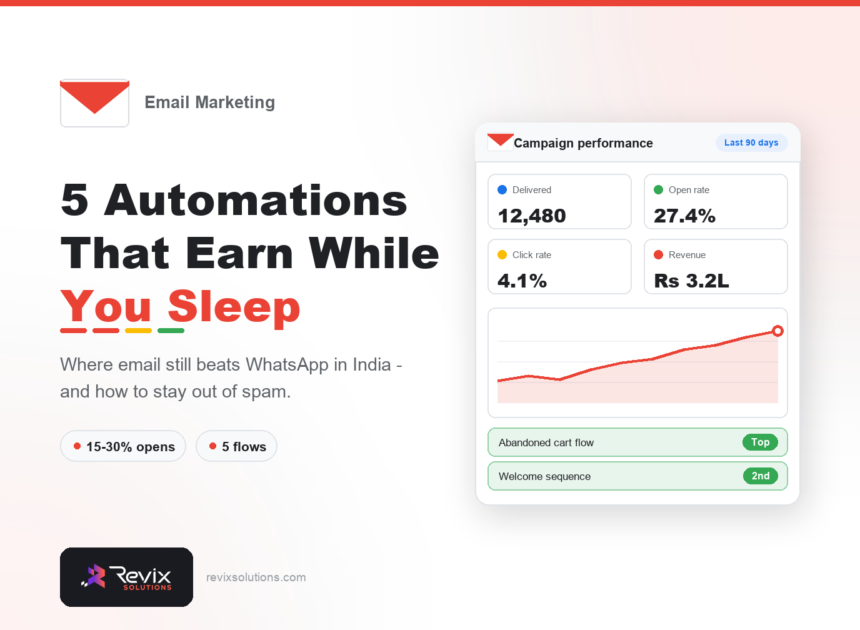
Email marketing in India is neither dead nor universally useful. For B2B, education, e-commerce and any business with repeat purchases, it remains the cheapest revenue channel available. For a local plumber, WhatsApp will outperform it every time. This guide covers where email genuinely works, the automated flows worth building, and how to stay out of the spam folder. Done properly, email marketing for Indian businesses is still the cheapest revenue channel available.
Email marketing for Indian businesses is the use of permission-based email to generate repeat revenue, mainly in B2B, education and e-commerce.
The short answer
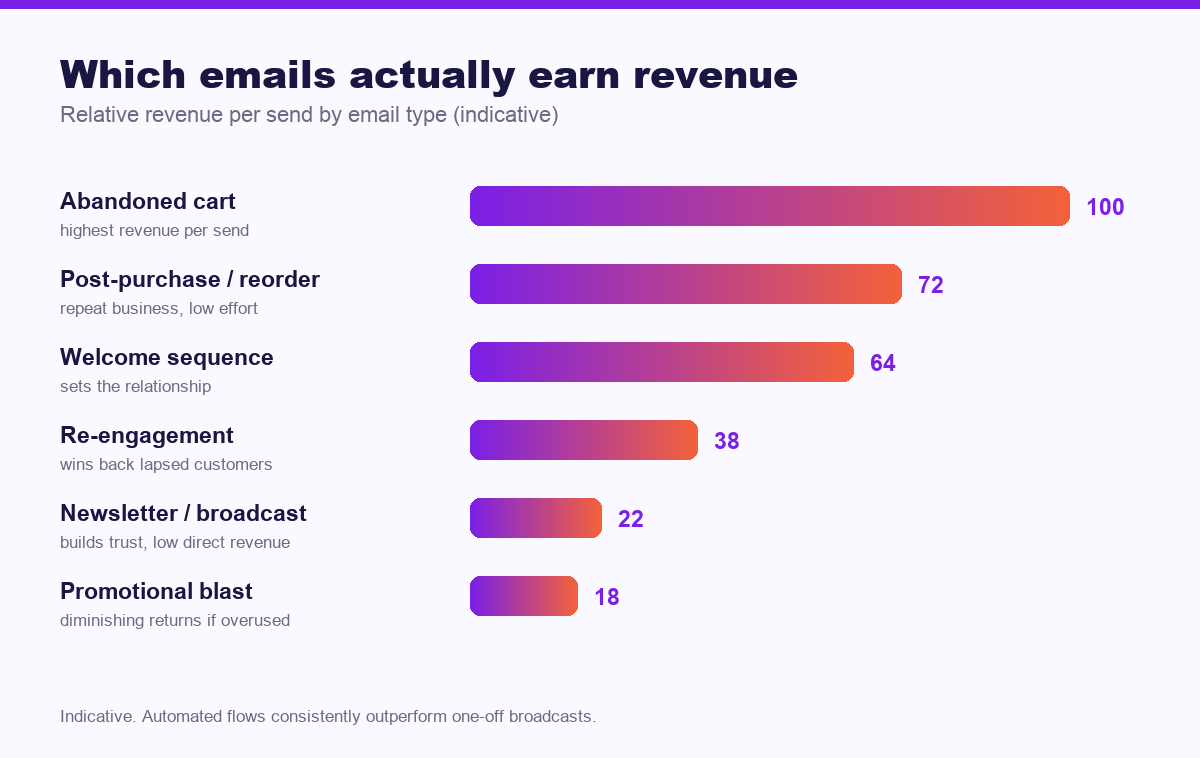
Build the list with genuine opt-in, authenticate your domain with SPF, DKIM and DMARC, and prioritise automated flows over broadcasts. Five automations – welcome, abandoned cart, post-purchase, re-engagement and reorder reminders – produce most of the revenue while requiring setup once. Send once or twice monthly rather than weekly.
When email is the right channel
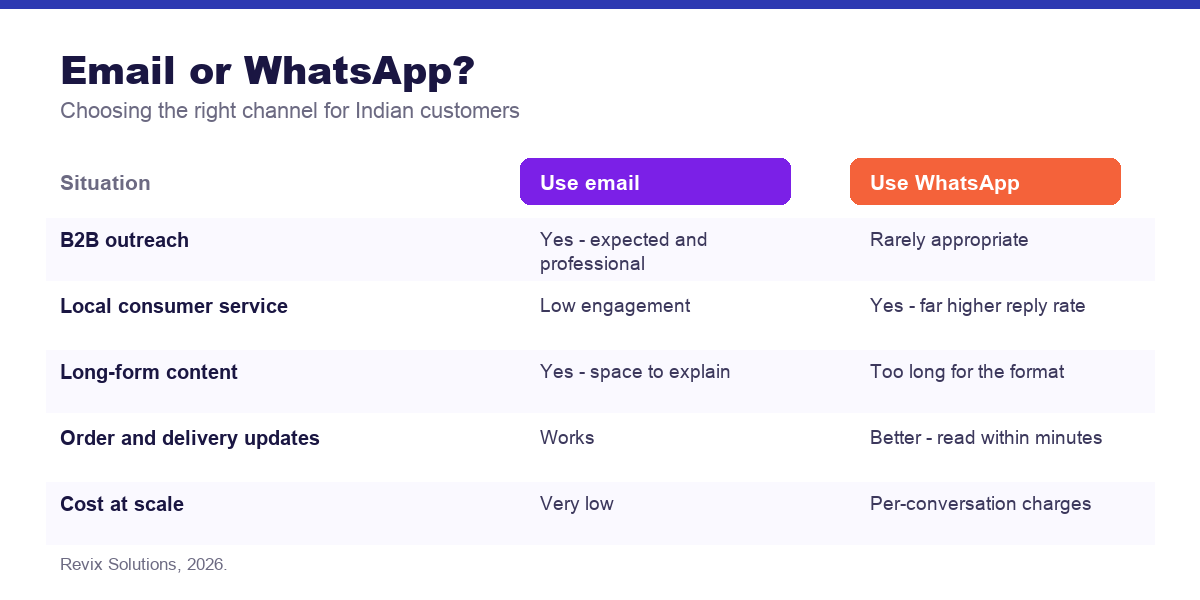
Email works well when the decision takes time, the content needs space, or the relationship is professional. It works poorly when the customer expects an immediate reply, which describes most local consumer services in India.
If you sell to businesses, run courses, ship products or have customers who buy repeatedly, email deserves investment. If you are a local trade responding to emergencies, put that effort into WhatsApp and your Google Business Profile instead.
Building a list worth sending to
List quality determines everything downstream. A thousand genuine subscribers outperform ten thousand scraped addresses, which will simply destroy your sender reputation.
- Offer something specific in exchange. A price guide, a checklist, a sample lesson. “Subscribe to our newsletter” converts poorly.
- Collect at natural moments — after purchase, after an enquiry, at checkout.
- Never buy lists. Beyond the legal exposure, it destroys deliverability for your legitimate mail.
- Confirm the opt-in where possible. It reduces list size and improves every metric that matters.
The five automations worth building
| Flow | Trigger | Why it works |
|---|---|---|
| Welcome sequence | New subscriber | Highest engagement window you will ever have |
| Abandoned cart | Checkout not completed | Recovers customers who already chose to buy |
| Post-purchase | Order delivered | Drives reviews and repeat purchases |
| Reorder reminder | Time since last purchase | Effortless revenue for consumables |
| Re-engagement | No opens in 90 days | Wins some back and lets you clean the rest |
Staying out of spam
Most Indian small businesses that struggle with email have a deliverability problem rather than a content problem. Fix the technical foundation first.
- Set up SPF, DKIM and DMARC records on your sending domain. This is the single most important step, and it is a one-time task.
- Send from your own domain, not a free Gmail or Yahoo address.
- Warm up new domains gradually rather than sending to your whole list on day one.
- Remove unengaged subscribers after six months. Sending to people who never open teaches providers your mail is unwanted.
- Make unsubscribing easy. A hidden unsubscribe link converts irritated readers into spam complaints, which are far more damaging.
Writing emails people open
Subject lines decide opens; the first line decides whether anyone keeps reading. Be specific rather than clever — “Your order ships tomorrow” outperforms “Exciting news inside” reliably.
Keep emails short enough to read on a phone in under a minute, use one clear call to action rather than five competing links, and write in the voice you would use speaking to that customer. Regional language works well where your audience uses it.
What to measure
Open rates have become unreliable because of privacy protections that pre-load images. Judge campaigns on clicks, replies and revenue attributed to the send. A campaign with a modest open rate that produces five orders beat one with a high open rate and none.
Frequently asked questions
Is email marketing still effective in India?
In practice, email marketing for indian businesses follows the same rules for most businesses. Yes for B2B, education, e-commerce and any business with repeat purchases. For local consumer services WhatsApp usually performs better, so the honest answer depends on your customer type.
What is a good email open rate in India?
Typical open rates run between 15 and 30 percent depending on industry and list quality. Reported open rates are less reliable than they were because of privacy protections, so judge campaigns on clicks and replies.
How often should I send marketing emails?
For most Indian small businesses, once or twice a month is sustainable and well tolerated. Frequency matters less than consistency and relevance – irregular sending damages deliverability.
Do I need consent to send marketing emails in India?
You should always collect explicit opt-in and provide a working unsubscribe link. Beyond legal exposure, sending without consent damages sender reputation and pushes future mail into spam folders.
What is the best day to send emails in India?
Tuesday to Thursday mornings generally perform best for B2B, while weekends can work for consumer offers. Test with your own list rather than relying on general benchmarks.
Why do my emails land in spam?
The usual causes are missing SPF, DKIM and DMARC records, sending to purchased lists, spam-trigger subject lines, and low engagement. Authentication records are the first thing to fix.
If you would rather have email marketing for indian businesses handled for you, our email marketing services and content writing services cover exactly the work described above.
Because of that, email marketing for indian businesses rewards consistency far more than intensity.
Email marketing for indian businesses: what to do next
The short version of this guide: email marketing for indian businesses rewards sequence over effort. Fix the foundations first, publish what your customers actually search for, then measure enquiries rather than rankings. Businesses that treat email marketing for indian businesses as a system rather than a checklist are the ones still compounding a year later.
Sitting on a customer list you never email?
We will review your list, set up domain authentication so your mail actually arrives, and build the automated flows that earn revenue without you sending anything manually.
Plans start from Rs 16,000 per month. See current pricing.
Related reading: WhatsApp business marketing in India, e-commerce SEO in India.