
E-commerce seo in india is the subject of this guide, so here is the short version first. E-commerce SEO in India means competing against marketplaces that outrank almost everyone on generic terms. The businesses that succeed do not fight Amazon on “running shoes” — they win long-tail, brand and guide-led searches where marketplaces are weak. This guide covers the page structure, technical foundations and content strategy that produce organic sales for Indian online stores. Successful e-commerce SEO in India means picking the battles you can actually win.
E-commerce seo in india: the short answer
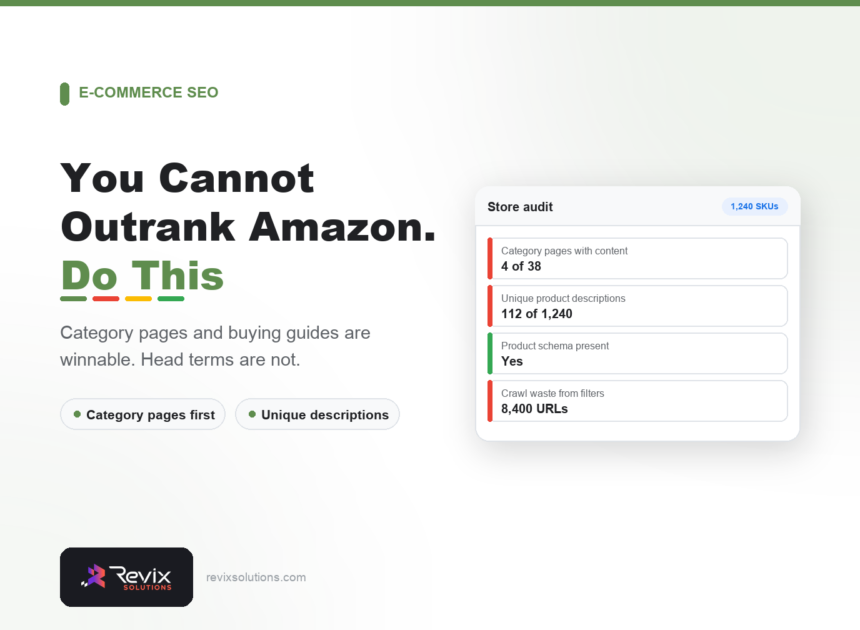
Optimise category pages before product pages — they have the best ranking potential and are usually neglected. Write genuinely unique product descriptions instead of manufacturer copy. Fix crawl waste from filters and parameters. Then build buying guides, because that is the one content type where an independent store consistently outranks marketplaces.
The honest competitive picture
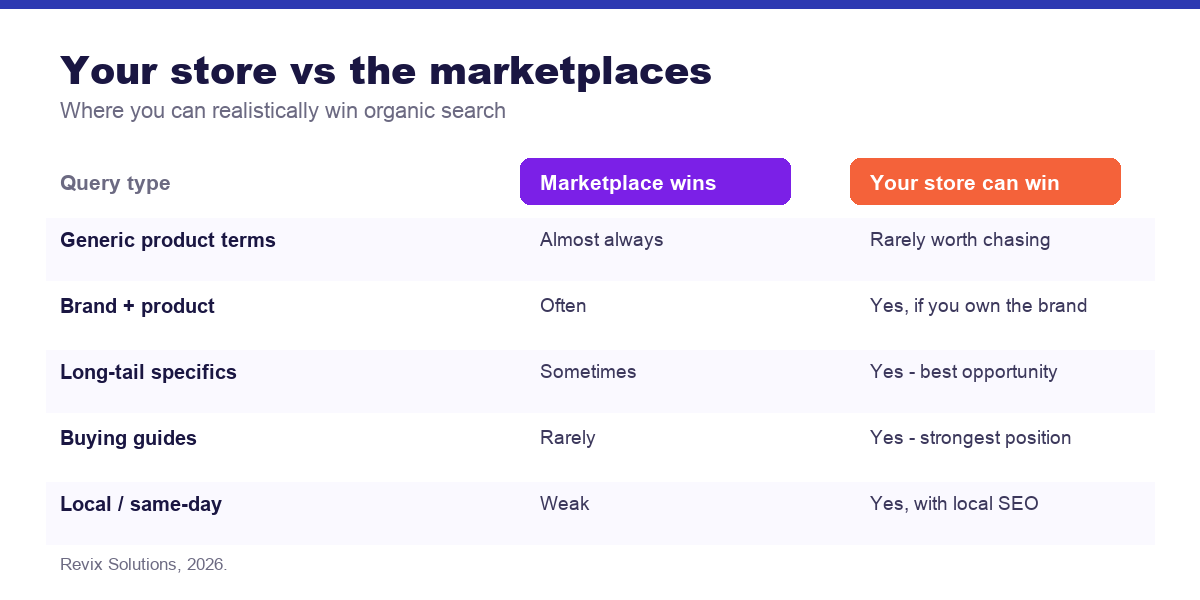
Search “bluetooth headphones” in India and the first page is marketplaces. That is not a failure of your SEO; it reflects domain authority built over a decade. Chasing those terms burns budget.
What works instead is specificity. “Bluetooth headphones with 40 hour battery under 3000” has less volume and far less competition, and the person searching it is closer to buying. Aggregate enough of these and you build meaningful revenue without ever ranking for the head term.
Category pages: the biggest missed opportunity
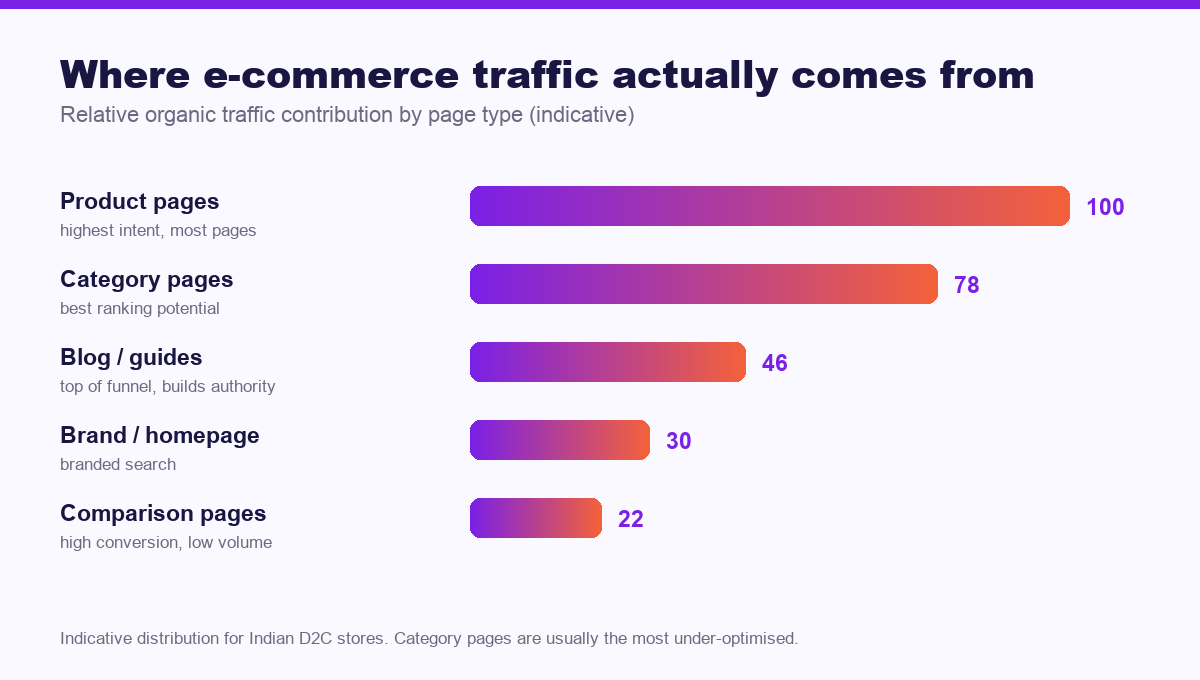
Most Indian stores have category pages containing a heading and a product grid. That gives Google almost nothing to rank. Category pages target broader, higher-volume terms than any single product, and they convert well because they present choice.
- Add 200–400 words of genuinely useful introduction covering what to consider when choosing, not keyword filler.
- Use a descriptive H1 matching how people search: “Men’s Running Shoes” rather than “Category”.
- Add FAQs answering sizing, materials, warranty and delivery questions.
- Link to your best sub-categories and guides from within the copy.
Product pages that rank and convert
| Element | What to do | Why |
|---|---|---|
| Title | Brand + model + key attribute | Matches how people search |
| Description | Rewrite, never copy manufacturer text | Duplicate content across sellers cannot rank |
| Images | Multiple angles, descriptive alt text, compressed | Image search plus page speed |
| Reviews | Enable and display on page | Fresh unique content and conversion lift |
| Schema | Product with price and availability | Rich results in search |
| Stock handling | Keep URL live, suggest alternatives | Deleting pages destroys accumulated rankings |
Never delete out-of-stock product pages
A page that ranks has accumulated value. Deleting it wastes that entirely. Keep it live, mark it unavailable, and surface similar products. If the product is permanently discontinued, redirect to the closest equivalent rather than to the homepage.
Technical foundations that matter most
- Control filter and parameter URLs. Faceted navigation can generate thousands of near-duplicate pages that exhaust crawl budget. Use canonical tags and robots directives deliberately.
- Fix pagination. Ensure crawlers can reach every product through category pages within three clicks.
- Prioritise mobile speed. Most Indian e-commerce traffic is mobile, often on variable connections. Compress images and defer non-critical scripts.
- Implement Product schema properly, including price, currency, availability and reviews.
- Keep URLs stable. Every migration that changes URLs without redirects resets your progress.
Buying guides: where you beat marketplaces
This is the strongest organic opportunity for an Indian store. Marketplaces are poor at editorial content, and Google frequently ranks independent guides above them for research queries.
Write guides that genuinely help someone decide: how to choose a mattress firmness for back pain, what to look for in a first DSLR, which fabric suits Indian summers. Link naturally to relevant products. These pages attract people earlier in the journey and build the topical authority that later helps your product pages rank.
Local SEO for stores with physical presence
If you have a shop or offer same-day delivery in specific cities, this is an advantage marketplaces struggle to match. Complete your Google Business Profile, create genuine city pages, and make delivery timeframes explicit. “Same-day delivery in Chandigarh” is a claim no national marketplace can make as credibly.
Mistakes that cost Indian stores rankings
- Copying manufacturer descriptions. Identical text across hundreds of sellers cannot rank for any of them.
- Thin category pages. A product grid with no content has nothing to rank on.
- Deleting discontinued products instead of redirecting.
- Ignoring internal search data. What visitors type into your site search is free keyword research.
- Blocking crawlers from filtered pages after they already rank without checking what you are removing.
- Chasing head terms that marketplaces will hold indefinitely.
Frequently asked questions
How long does e-commerce SEO take in India?
In practice, ecommerce seo in india follows the same rules for most businesses. Category and product page improvements typically show movement within two to four months. Competing for broader commercial terms usually takes six to twelve months, depending on your domain’s existing authority.
Can a small store outrank Amazon or Flipkart in India?
Rarely on generic product terms, but frequently on long-tail searches, brand-specific queries and buying guides. Concentrating on those categories is a far better use of budget than competing head-on.
Should I write unique descriptions for every product?
Yes for your important products. Manufacturer copy appears on dozens of competing sites and cannot rank. If you have thousands of SKUs, prioritise your top sellers and highest-margin items first.
What should I do with out-of-stock products?
Keep the page live, mark it unavailable and suggest alternatives. Only redirect if the product is permanently discontinued, and redirect to the closest equivalent rather than the homepage.
Is Shopify or WooCommerce better for SEO in India?
Both can rank well. WooCommerce offers more technical control and lower running costs, while Shopify handles performance and security with less maintenance. Platform matters far less than content quality and site structure.
How much does e-commerce SEO cost in India?
Entry-level e-commerce SEO starts from around Rs 16,000 per month for a small catalogue. Larger stores with thousands of products typically need Rs 40,000 to Rs 80,000 per month for meaningful coverage.
If you would rather have ecommerce seo in india handled for you, our e-commerce SEO services and Shopify development cover exactly the work described above.
Because of that, e-commerce seo in india rewards consistency far more than intensity.
However, e-commerce seo in india only compounds when the basics stay in place month after month.
In practice, most businesses underestimate how long e-commerce seo in india takes to show results.
As a result, e-commerce seo in india works best when it is measured against enquiries rather than rankings.
That said, e-commerce seo in india is not a one-off project, and treating it as one is the usual mistake.
Ecommerce seo in india: what to do next
The short version of this guide: ecommerce seo in india rewards sequence over effort. Fix the foundations first, publish what your customers actually search for, then measure enquiries rather than rankings. Businesses that treat ecommerce seo in india as a system rather than a checklist are the ones still compounding a year later.
Getting traffic but not enough orders?
We will audit your category structure, product pages, technical crawl issues and content gaps, then show you which changes will produce organic sales fastest.
Plans start from Rs 16,000 per month. See current pricing.
Related reading: 30-day budget SEO plan for Indian small businesses, key e-commerce trends.