Web development courses in india still teach a syllabus written before AI coding tools existed, and a meaningful part of it is now wasted effort. Some of it matters more than ever. Knowing which is which saves you months.
The short answer
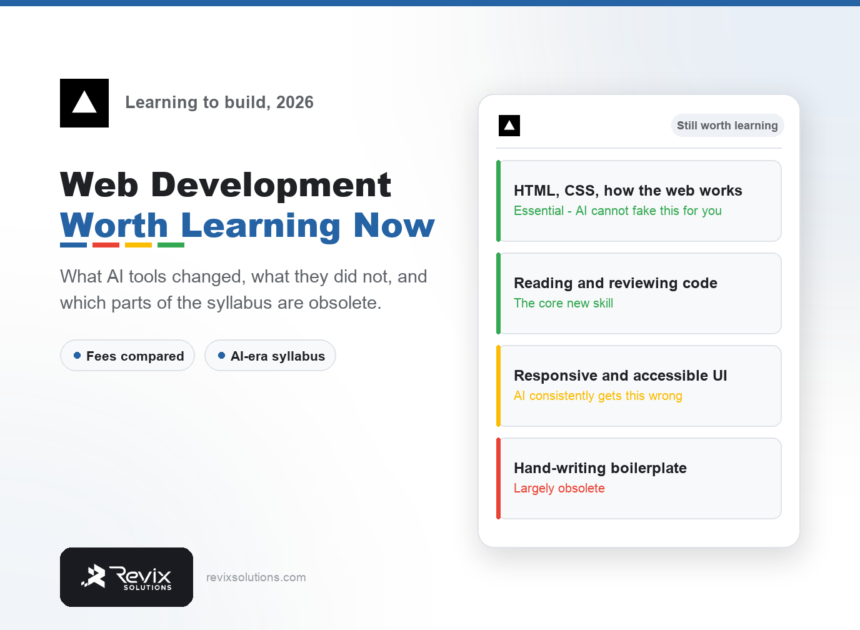
Learn how the web actually works – HTML, CSS, requests, deployment – because you cannot review what you do not understand. Reading and correcting AI-generated code is the new core skill. Hand-writing boilerplate is largely obsolete. Responsive behaviour and accessibility still need you, because AI tools get both wrong consistently.
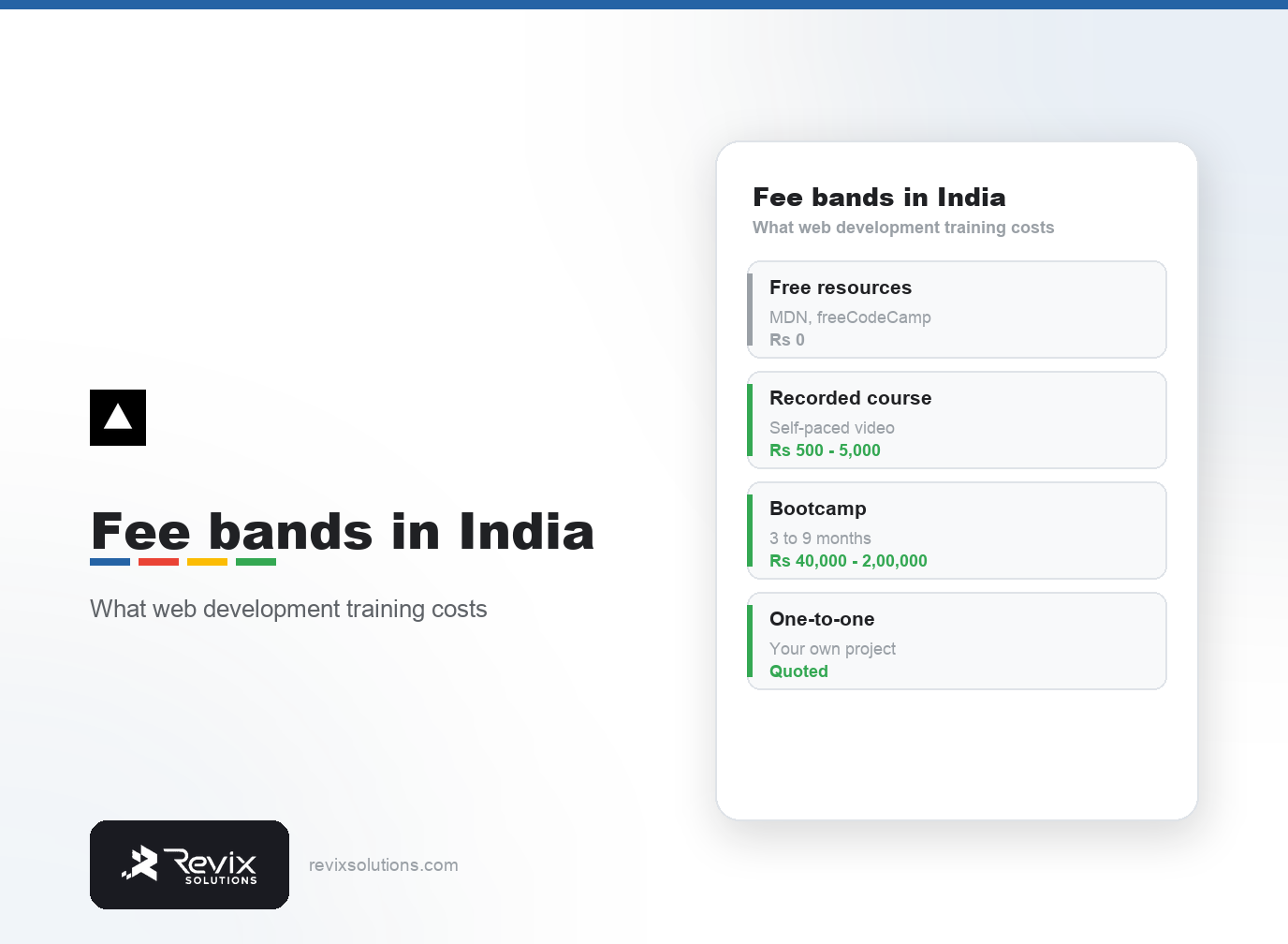
What web development courses in india cost
| Format | Typical fee | Duration |
|---|---|---|
| Free resources | Rs 0 | Self-paced |
| Recorded course | Rs 500 – 5,000 | 20 to 60 hours |
| Institute programme | Rs 40,000 – 90,000 | 3 to 6 months |
| Premium bootcamp | Rs 1,00,000 – 2,00,000 | 6 to 9 months |
| One-to-one mentoring | Quoted | You set the pace |
What AI tools actually changed
Scaffolding a project, writing boilerplate, wiring up components – these went from hours to minutes. If a course spends 3 weeks on syntax drills, it is teaching you to do by hand what a tool now does in seconds.
What did not change: knowing whether the output is correct. That requires understanding the thing you are reviewing, which is why skipping fundamentals backfires.
In practice, web development courses in india rewards specifics over generalities.
That said, web development courses in india only matters if you act on what you find.
A reasonable learning path now
- 2 weeks on fundamentals. HTML, CSS, how a request works.
- Build one real page by hand. Badly is fine.
- Then bring in AI tools and notice what they get wrong.
- Learn to review – responsive states, focus states, contrast.
- Deploy it. A site nobody can visit taught you half the lesson.
If you would rather do that with someone reviewing each step, Our one-to-one AI website development course covers exactly this, one-to-one and online.
If you would rather have web development handled for you instead of learning it, our website development services and WordPress development cover the same ground as done-for-you work.
Want to build your own site rather than commission one?
Book a free 20-minute call, describe what you want to build, and I will tell you whether learning it or buying it is the better use of your money.
Book a free 20-minute callSessions are one-to-one, online, and scheduled around your week.
Frequently asked questions
What is the fee for web development courses in India?
Recorded courses cost Rs 500 to 5,000. Institute programmes run Rs 40,000 to 90,000. Premium bootcamps reach Rs 2,00,000, largely on the strength of placement claims.
Can I learn web development for free?
Yes. MDN and freeCodeCamp are genuinely excellent and free. Paying buys structure and feedback, not better information.
Do I still need to learn coding if AI can write it?
You need to read it, which means understanding it. You need far less practice writing it from memory than courses currently assume.
How long does it take to learn web development?
Building something real takes 4 to 8 weeks with AI assistance. Being trusted with someone else’s project takes longer.
Is a bootcamp worth Rs 1,00,000?
Only for the placement network, and only if that network is real. Ask for verifiable outcomes from the last two cohorts before paying.
Which is better, WordPress or coding a site?
WordPress if non-technical people must edit it. A coded static site if speed matters most. Both are legitimate and the choice depends on who maintains it.