

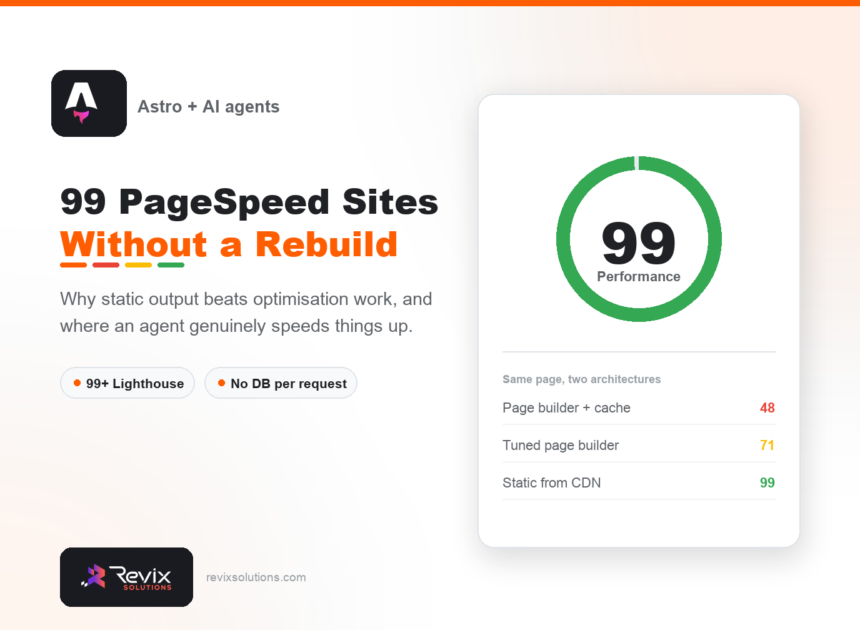
Building static sites with ai agents is a way of removing the delay before optimisation even starts. A page-builder site renders on every request and loads dozens of scripts; a static site ships finished HTML from a CDN. That difference is structural, and no amount of caching closes it.
The short answer
Static generators output plain HTML at build time, so there is no database query and no server render per visit. An AI agent can scaffold the structure, styling and components in minutes. What it cannot do is decide your information architecture or write content that earns links – that judgement stays with you.
Why static sites with ai agents outperform tuned page builders
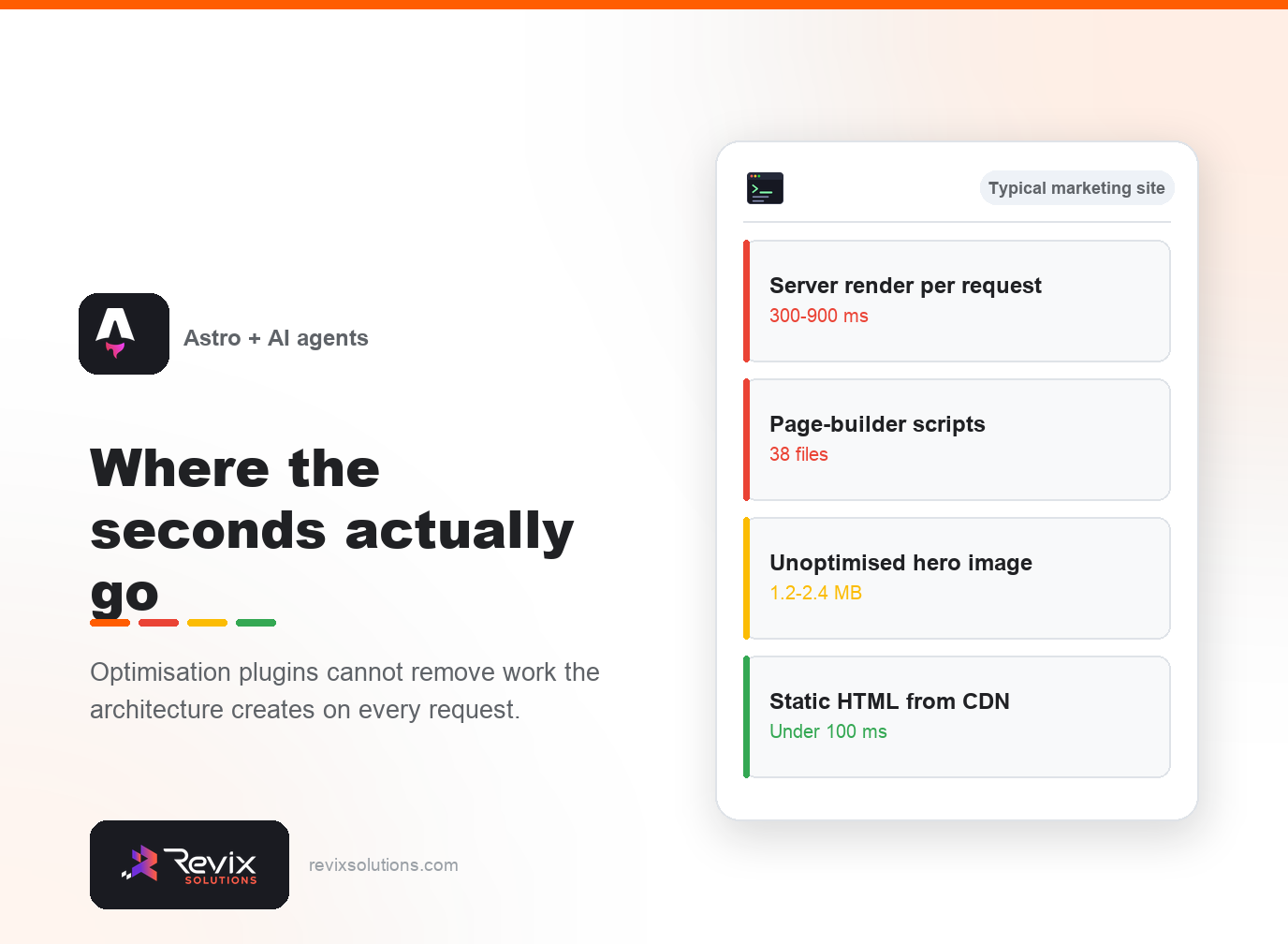
Optimising a page-builder site means fighting its architecture. Removing the architecture is faster than tuning it, which is why static output reaches scores that plugins cannot.
| Approach | Typical Lighthouse | Effort to maintain |
|---|---|---|
| Page builder + caching plugins | 35-60 | Ongoing, fragile |
| Page builder, heavily tuned | 60-80 | High |
| Static generator, default build | 90-99 | Low |
| Static + compressed images | 95-100 | Low |
What the agent actually does
Scaffolding, component structure, styling and build configuration – the mechanical layer. It is fast at producing a working shell and consistent at applying a design system across pages.
It is poor at deciding what the site should contain. Point it at a clear brief and it saves days; point it at a vague one and it produces a tidy site nobody needs.
In practice, static sites with ai agents rewards small scoped changes over sweeping ones.
However, static sites with ai agents only pays off when every change is reviewed before it ships.
That said, static sites with ai agents does not remove the need for someone who understands the business.
When static is the wrong answer
- Per-user content or complex logged-in states.
- Frequent real-time updates where rebuild time becomes a bottleneck.
- Teams with no deployment pipeline – static assumes a build step exists.
Most marketing sites hit none of these, which is why the trade rarely costs anything real.
Frequently asked questions
What makes a static site faster?
A static site ships pre-built HTML with no database query or server render per request. That removes the largest source of delay before any optimisation work begins.
Do I lose a CMS by going static?
No. Static site generators pull content from a headless CMS or markdown at build time, so editors keep an interface while visitors get plain HTML.
Is a 99 Lighthouse score realistic?
On a static site with compressed images and minimal JavaScript, yes. On a page-builder site loading 38 scripts, it is not, regardless of effort.
Can an AI agent scaffold the whole site?
It can scaffold structure, styling and components quickly. Content, information architecture and commercial decisions still need you.
Does static hosting cost less?
Usually. Static files serve from a CDN with no application server, which removes a running cost and a failure point.
When is static the wrong choice?
When you need per-user content, complex logged-in states or frequent real-time updates. Marketing sites rarely do.
If you would rather have static sites with ai agents handled for you, our website development services and website optimisation cover exactly this work.
Site slow and nothing is fixing it?
We audit whether your speed problem is tuneable or structural, and tell you honestly which one you have before quoting any work.
Plans start from Rs 16,000 per month. See current pricing.
Related reading: Core Web Vitals optimization guide, website design cost in India.