
Most keyword research fails because it starts with a tool instead of a customer. Tools tell you volume; they do not tell you which searches lead to someone paying you. This guide covers a practical method for Indian businesses, how to judge intent, and the Hinglish and regional patterns that most keyword research misses entirely. Useful keyword research for Indian businesses starts with the words customers actually say on the phone.
Keyword research for Indian businesses is the process of finding the search terms customers actually type, including Hinglish and locality variants.
The short answer
Start with the words customers actually use when they call you. Expand them with Google autocomplete and Keyword Planner, add city and locality modifiers, and check Hinglish variants. Then sort by intent rather than volume – service plus city plus cost queries convert far better than high-volume generic terms you will never rank for. Map one primary keyword to one page.
Start with your own phone
Before opening any tool, write down the exact phrases customers use when they contact you. Not the industry terminology — the words they actually say. Customers do not ask for “residential electrical remediation”; they say their fan stopped working.
This is the highest-quality keyword source available and almost nobody uses it. Every phrase is validated by a real person who was ready to pay.
Expanding the list
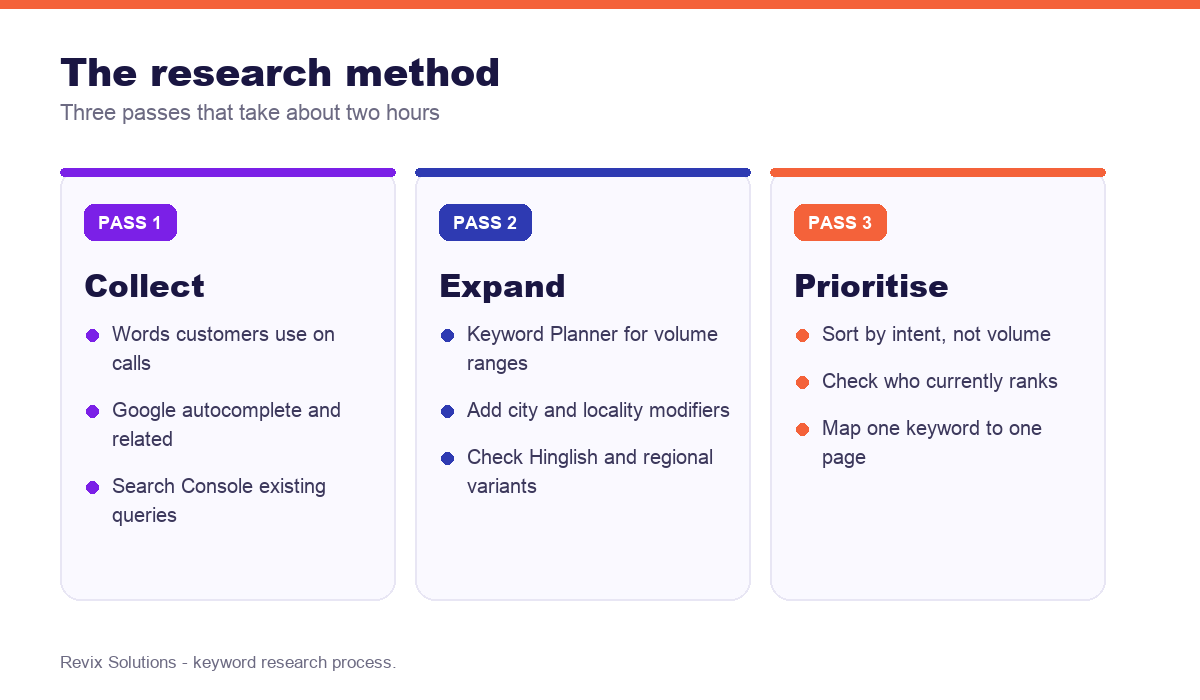
- Google autocomplete. Type your core service and note every suggestion. These are real searches, ordered by frequency.
- People Also Ask and Related Searches. Free, current, and directly reflect how Google groups the topic.
- Search Console. If your site has any history, the Performance report shows queries you already appear for. Terms where you rank between positions eight and twenty are the fastest wins available.
- Google Keyword Planner. Free with an Ads account. It shows broad volume ranges rather than exact numbers unless you are spending, which is sufficient for prioritising.
- Competitor pages. Look at the page titles and headings of businesses ranking above you.
Sorting by intent, not volume
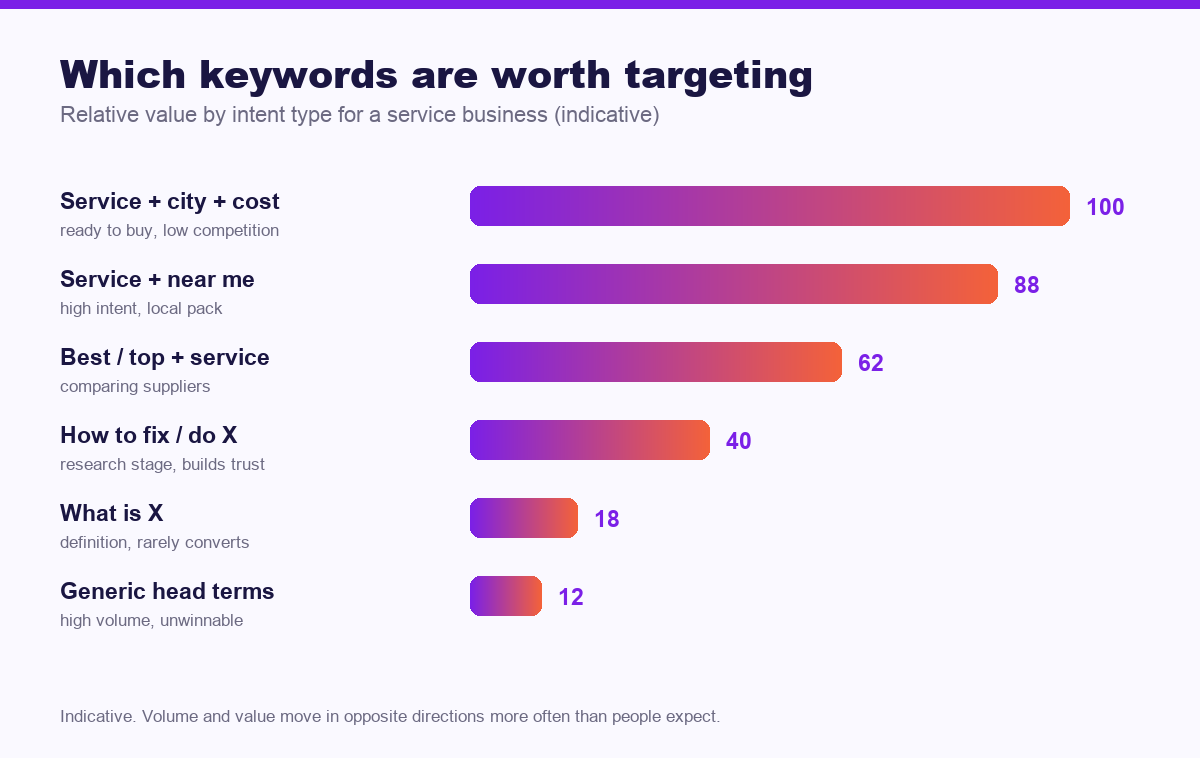
| Intent | Example | Page type | Converts? |
|---|---|---|---|
| Transactional | “gst consultant in mohali fees” | Service page | Very well |
| Local | “electrician near me” | Location or profile | Very well |
| Commercial | “best crm for small business india” | Comparison guide | Well |
| Informational | “how to file gst return” | Blog guide | Slowly, builds trust |
| Navigational | “justdial login” | Not worth targeting | No |
The volume trap
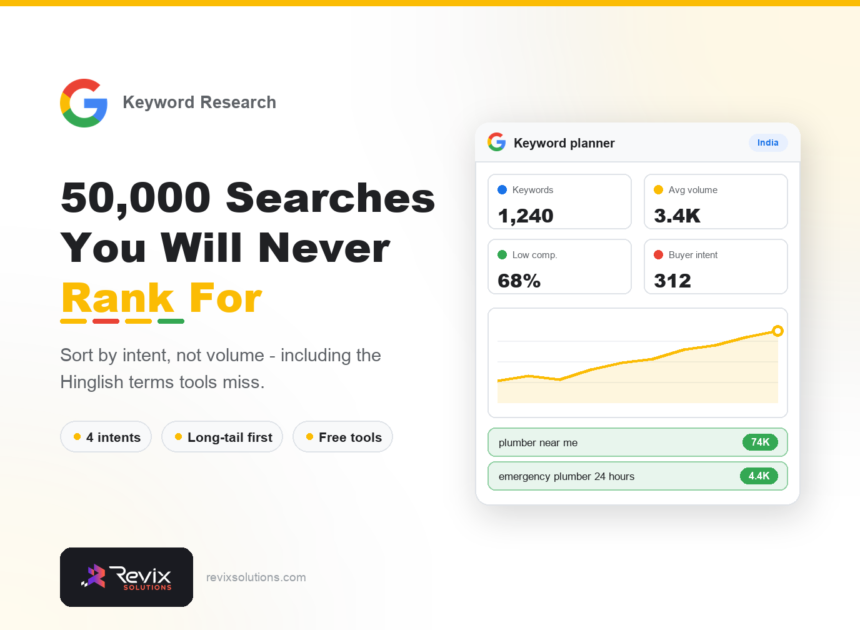
A keyword with 50,000 monthly searches that you will never rank for is worth nothing. A keyword with 90 searches that converts at 10% and brings customers worth Rs 30,000 each is worth a great deal. Prioritise by expected revenue, not by the biggest number in the spreadsheet.
Patterns specific to Indian search
Three things are routinely missed in keyword research done for Indian businesses.
- Hinglish and transliteration. People search “ghar ka naksha,” “kirayedar agreement,” “sasta” alongside English terms. Keyword tools underrepresent these badly, so check autocomplete manually.
- Locality-level modifiers. Indian cities search by sector, colony and landmark far more than by city name. “Plumber sector 20 panchkula” is a real and winnable search.
- Price sensitivity in the query. “Cheap,” “affordable,” “cost,” “charges” and “fees” appear in Indian commercial searches at high rates and carry genuine buying intent.
Mapping keywords to pages
One primary keyword per page, with a handful of close variants. Two pages targeting the same term compete with each other and usually result in neither ranking — the keyword cannibalisation problem that quietly limits many Indian small business sites.
Build a simple sheet: keyword, intent, the page that owns it, and current position. That document is your content plan, and it prevents the most common structural mistake in SEO.
Checking whether you can actually win
Before committing to a keyword, search it and look at who ranks. If the first page is entirely large national brands and marketplaces, pick a longer-tail variant instead. If it contains local businesses of roughly your size, you have a genuine opportunity.
Frequently asked questions
How do I do keyword research for an Indian business?
In practice, keyword research for indian businesses follows the same rules for most businesses. Start with the words your customers actually use when they call you, expand them with Google Keyword Planner and autocomplete, then filter for terms where intent matches what you sell.
Is Google Keyword Planner free?
Yes, though it shows broad volume ranges unless you run an active Google Ads campaign. The ranges are sufficient for prioritising topics.
What is search intent?
Search intent is what the searcher wants – to learn, to compare, to buy, or to find a specific site. Matching page type to intent matters more than matching keywords.
Should I target high-volume or long-tail keywords?
Long-tail terms first for most small businesses. They are less competitive, convert better, and collectively deliver more revenue than a single head term you cannot rank for.
How many keywords should one page target?
One primary keyword plus a handful of closely related variants. Trying to rank a single page for unrelated terms usually results in ranking for none of them.
How do I find keywords my competitors rank for?
Search your core terms and study who appears, then examine their page titles, headings and internal links. Search Console also shows queries you already appear for but rank poorly on.
If you would rather have keyword research for indian businesses handled for you, our SEO services and content writing services cover exactly the work described above.
Because of that, keyword research for indian businesses rewards consistency far more than intensity.
Keyword research for indian businesses: what to do next
The short version of this guide: keyword research for indian businesses rewards sequence over effort. Fix the foundations first, publish what your customers actually search for, then measure enquiries rather than rankings. Businesses that treat keyword research for indian businesses as a system rather than a checklist are the ones still compounding a year later.
Not sure which keywords are worth chasing?
We will build you a prioritised keyword map showing which terms you can realistically rank for, what each is worth, and which page should target it.
Plans start from Rs 16,000 per month. See current pricing.
Related reading: content marketing for service businesses, Google Ads cost in India.