
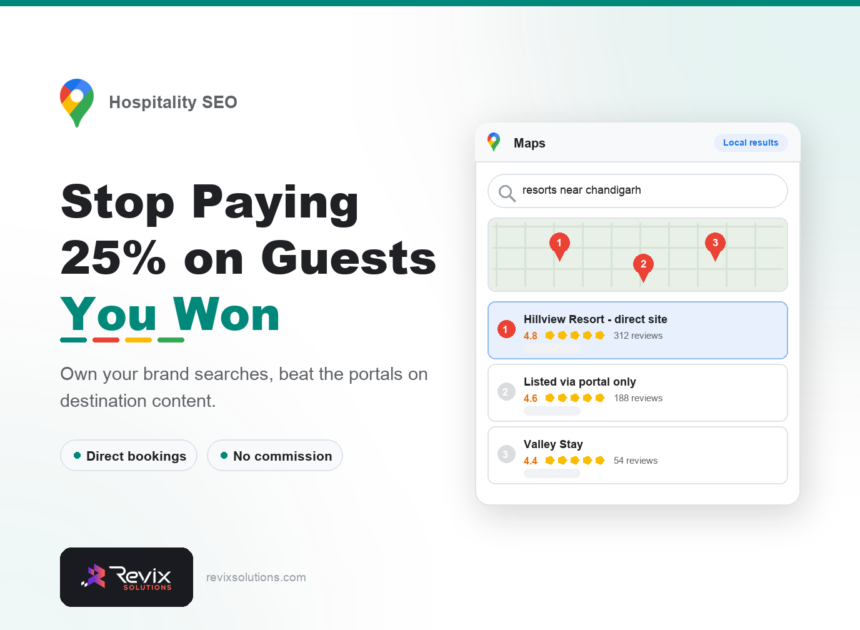
Every booking that arrives through a travel portal costs a hotel 15 to 25 percent in commission. The single highest-return SEO work an independent property can do is capture the travellers who already intend to stay with them — and then earn a share of the planning-stage searches portals handle poorly. This guide covers both, and what actually converts a visitor into a direct booking. Profitable SEO for hotels and resorts in India starts by winning back your own brand searches.
SEO for hotels and resorts in India is search work aimed at winning direct bookings instead of paying commission to travel portals.
Seo for hotels and resorts in india: the short answer
Own your brand searches first – anyone typing your hotel name should find your site and your best rate, not a portal listing. Then build destination content covering things to do, seasons and practical travel information, since portals do this badly. Publish rates that match or beat portal pricing, because travellers compare and a visibly better direct rate is your strongest argument.
Why direct bookings justify the work
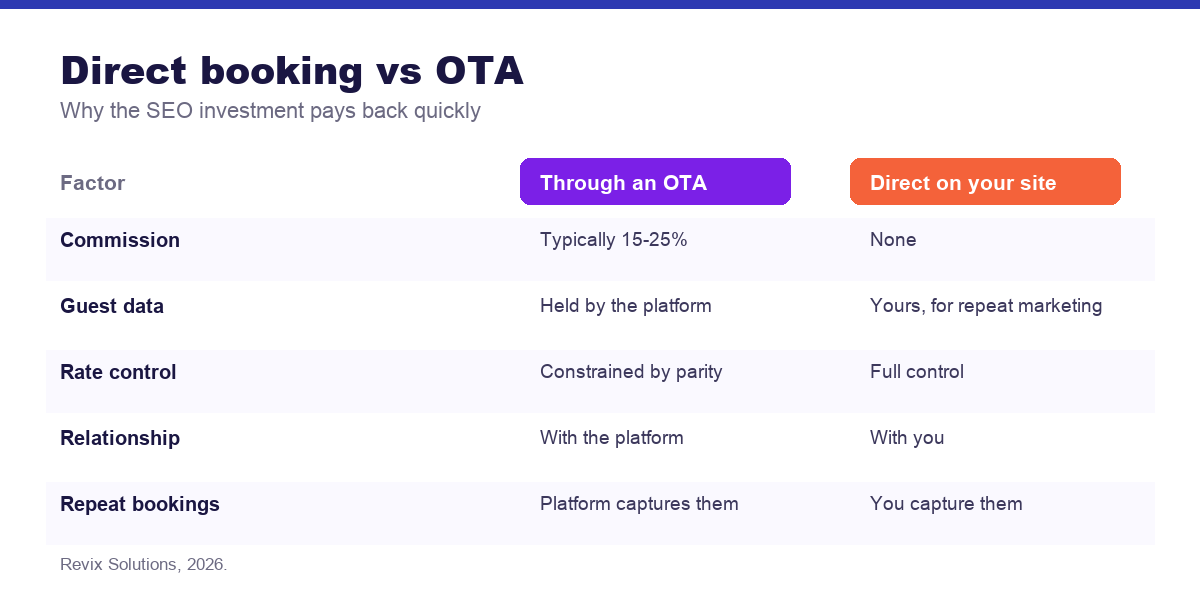
The arithmetic is unusually clear in hospitality. If your average booking is Rs 12,000 and commission is 18 percent, each direct booking saves roughly Rs 2,160. Ten additional direct bookings a month is over Rs 21,000 recovered — more than most SEO retainers cost.
Portals still deserve a place. They provide discovery you cannot replicate. But every guest who was going to book anyway should book with you.
Protecting your brand searches
This is the most overlooked opportunity in hotel marketing. Someone searching your property name has already decided. If a portal listing outranks your own site, you pay commission on a guest you had already won.
- Ensure your site ranks first for your exact property name, with a clear booking route above the fold.
- Complete your Google Business Profile with the booking link pointing to your own site.
- Add Hotel structured data so your details display properly in results.
- Consider a small branded ads budget if portals bid on your name, since defending your own brand term is usually cheap.
- State a direct-booking benefit plainly — best rate guarantee, free breakfast, early check-in. Give a reason to leave the portal.
Destination content: where you beat the portals
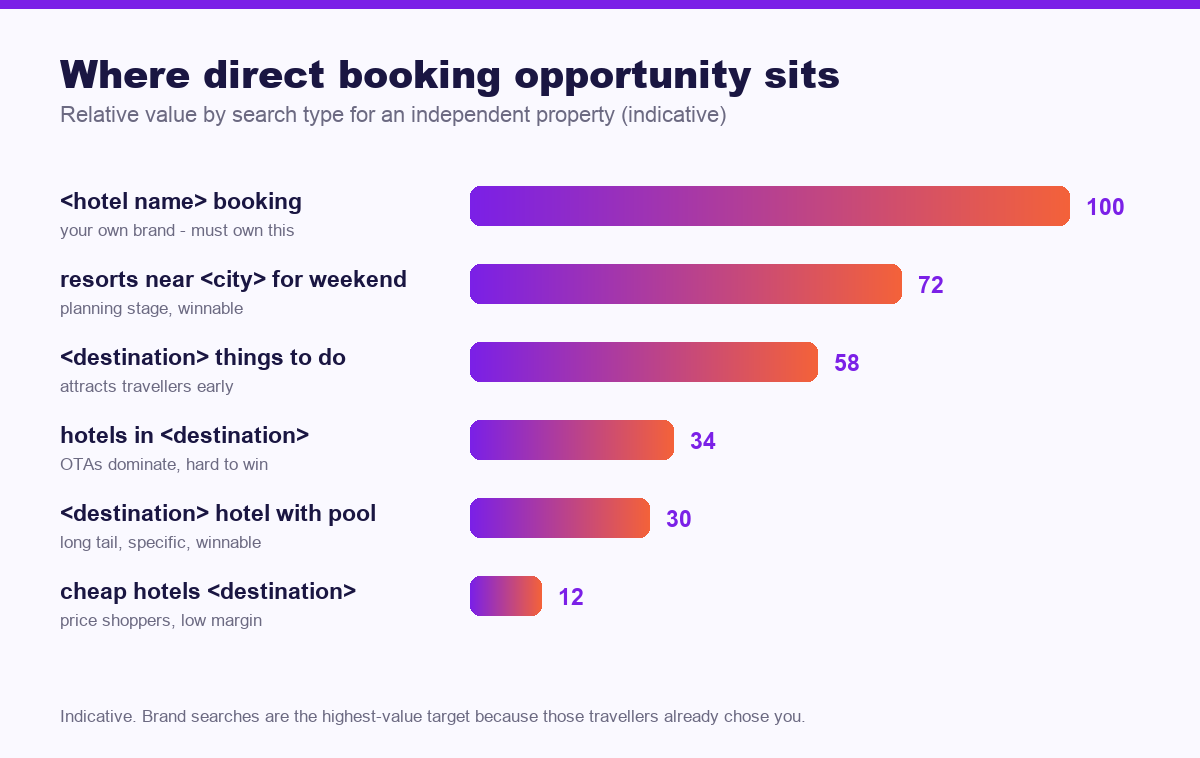
Travellers research for weeks before booking, and portals handle this stage poorly — their pages are listings, not guidance. A property with genuine local knowledge can own these searches.
Topics that consistently work include things to do within an hour of the property, the best months to visit and why, how to reach the destination from major cities, what to pack for the season, and honest guidance on which areas suit which type of traveller. Family, couple and workation angles each attract distinct audiences.
Be specific and local
Generic destination content competes with every travel blog. Content that only a property actually located there could write — which road floods in monsoon, where locals eat, when the market is closed — ranks better and converts better.
The pages a property needs
| Page | Targets | Should include |
|---|---|---|
| Room type pages | “[hotel] deluxe room” | Photos, amenities, occupancy, rate range |
| Destination guide | “things to do in [place]” | Genuinely local recommendations |
| Getting here | “how to reach [place]” | Routes, distances, transfer options |
| Season pages | “[place] in December” | Weather, crowds, what is open |
| Offers page | “[hotel] offers” | Direct-only rates and packages |
| Events and weddings | “resort for wedding in [place]” | High-value, low-competition segment |
Turning visitors into bookings
Traffic without a working booking flow is wasted. Three things matter most: the booking engine must work quickly on mobile, rates must be visible without requiring an enquiry, and photographs must be current, well-lit and of actual rooms rather than renders or dated imagery.
Compress those photographs properly. Hotel sites are among the slowest we audit, and a gallery that takes eight seconds on mobile data loses the guest before they see the room.
Reviews across platforms
Hospitality reputation is spread across Google, portals and travel review sites. Google reviews influence local visibility most directly, so build those deliberately — ask at checkout when the stay is fresh. Reply to everything, and treat criticism about specific fixable issues as free operational feedback.
What to expect
Brand and long-tail terms can move within two to four months. Competitive destination terms take six to twelve months and require sustained content. Because brand protection produces the fastest commission savings, start there rather than with the hardest terms.
Frequently asked questions
How do hotels get direct bookings from Google?
In practice, seo for hotels and resorts in india follows the same rules for most businesses. Through a complete Google Business Profile, strong local and destination content, and a fast booking flow. Direct bookings avoid OTA commission, so the return on this work is unusually high.
Can a hotel outrank booking portals?
Rarely for broad destination searches, but reliably for its own brand name and for specific long-tail queries. Owning your brand searches is the highest-value target because those visitors intend to book with you.
What content works for hotel SEO?
Destination guides, things to do nearby, event and season pages, and practical travel information. These attract travellers during planning rather than only at booking.
Should hotels publish room rates on their site?
Yes, and ideally match or better the rate available on portals. Travellers routinely compare, and a visibly better direct rate is the strongest argument for booking with you.
How important are photographs for hotel SEO?
Extremely. Accommodation is chosen visually, and both search engines and travellers respond to genuine, current, well-lit images of actual rooms rather than stock or dated photography.
How long does hotel SEO take?
Brand and long-tail terms can move within two to four months. Competitive destination terms take six to twelve months and require sustained content investment.
If you would rather have seo for hotels and resorts in india handled for you, our local SEO services and website optimisation cover exactly the work described above.
Because of that, seo for hotels and resorts in india rewards consistency far more than intensity.
Seo for hotels and resorts in india: what to do next
The short version of this guide: seo for hotels and resorts in india rewards sequence over effort. Fix the foundations first, publish what your customers actually search for, then measure enquiries rather than rankings. Businesses that treat seo for hotels and resorts in india as a system rather than a checklist are the ones still compounding a year later.
Paying commission on guests who already knew your name?
We will check whether your property outranks the portals for your own brand searches, review your booking flow and destination content, and show you where direct bookings are being lost.
Plans start from Rs 16,000 per month. See current pricing.
Related reading: Google Business Profile optimization guide, Core Web Vitals optimization guide.