

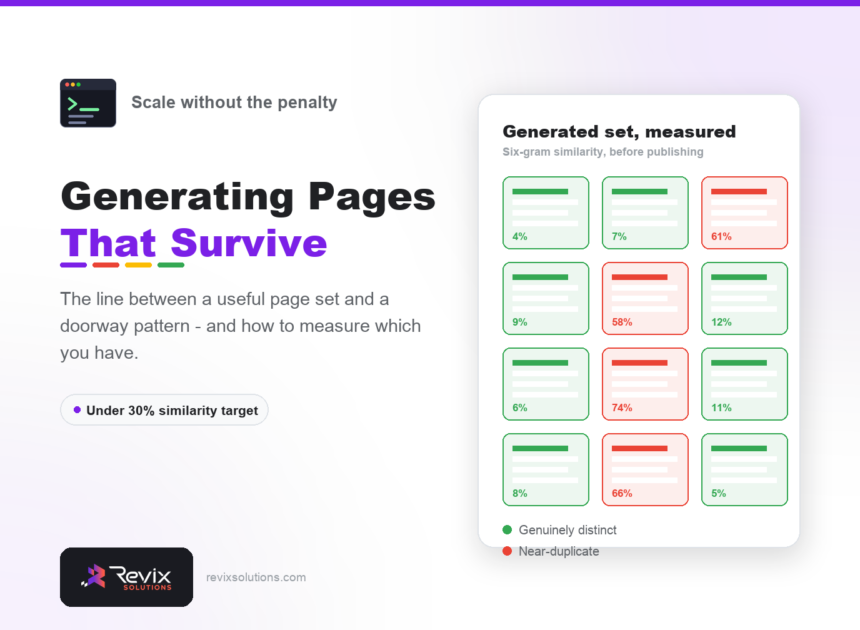
Programmatic page generation is the practice of creating many pages from a data source and a template. Done well it scales genuine coverage. Done badly it produces the doorway pattern Google’s spam policy names explicitly – and the difference is measurable rather than a matter of opinion.
The short answer
Generate pages only where you have genuinely different information to put in them. Measure pairwise similarity before publishing and treat anything above 30% as a rewrite, not a publish. Swapping a variable into a fixed sentence is not differentiation; it is detectable spun content, which reads worse than honest repetition.
The honest test for programmatic page generation
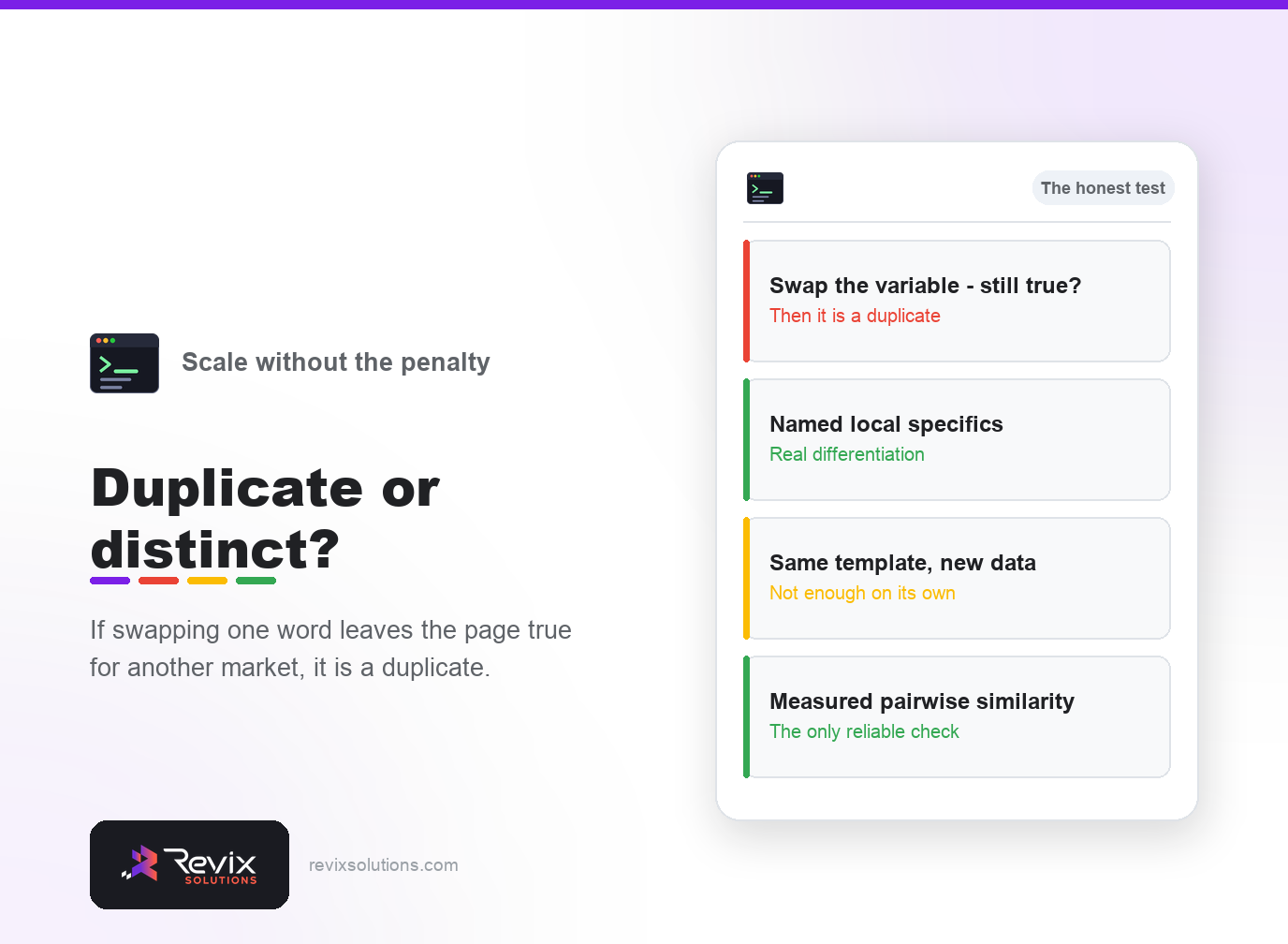
Read a generated page and ask whether any sentence would become false if you swapped the location or product. If most of it survives the swap, you have one page repeated, whatever the word count says.
| Signal | Duplicate pattern | Genuinely distinct |
|---|---|---|
| Body copy | Template with a token swapped | Written from real specifics |
| Data | Same figures everywhere | Varies per entity |
| Internal links | Identical footer list | Contextual and different |
| Measured similarity | Above 50% | Under 30% |
| Indexing outcome | Discovered, not indexed | Crawled and kept |
Measure before you publish
Six-gram Jaccard similarity across every pair is straightforward to compute and gives a number rather than an opinion. Set a threshold, reject above it, and rewrite rather than shipping.
The useful discipline is running it before publication. Measuring afterwards tells you what you already released.
In practice, programmatic page generation rewards small scoped changes over sweeping ones.
However, programmatic page generation only pays off when every change is reviewed before it ships.
That said, programmatic page generation does not remove the need for someone who understands the business.
Log every bulk change
Any script updating titles or descriptions at scale should record the field, the previous value and a timestamp. Without that, one bad run is unrecoverable and you will not know which pages changed.
Knowing when to stop
The limit is not a page count. It is how many pages you can make genuinely distinct and keep accurate as things change. Twelve strong pages consistently outperform two hundred thin ones, and they do not put the rest of the domain at risk.
Frequently asked questions
What is programmatic page generation?
Programmatic page generation creates many pages from a data source and a template, rather than writing each one by hand.
Is this the same as doorway pages?
It becomes doorway pages when the output is thin and near-identical. The difference is whether each page carries genuinely distinct, useful information.
How do I keep generated pages from being duplicates?
Vary the content, not just a variable. If swapping one word makes a page true for a different market, it is a duplicate.
Can meta descriptions be generated safely?
Yes, when built from real page data rather than a fixed sentence with a token swapped. Review a sample before applying at scale.
How many generated pages is too many?
There is no number. The limit is how many you can make genuinely distinct and keep accurate over time.
What should be logged?
Every field changed, the previous value and a timestamp. Without that you cannot roll back a bad bulk edit.
If you would rather have programmatic page generation handled for you, our website optimisation and SEO services cover exactly this work.
Planning to generate pages at scale?
We measure duplication across your existing set and tell you honestly whether scaling is safe before you build more.
Plans start from Rs 16,000 per month. See current pricing.
Related reading: multi-location SEO strategy, keyword research for Indian businesses.