
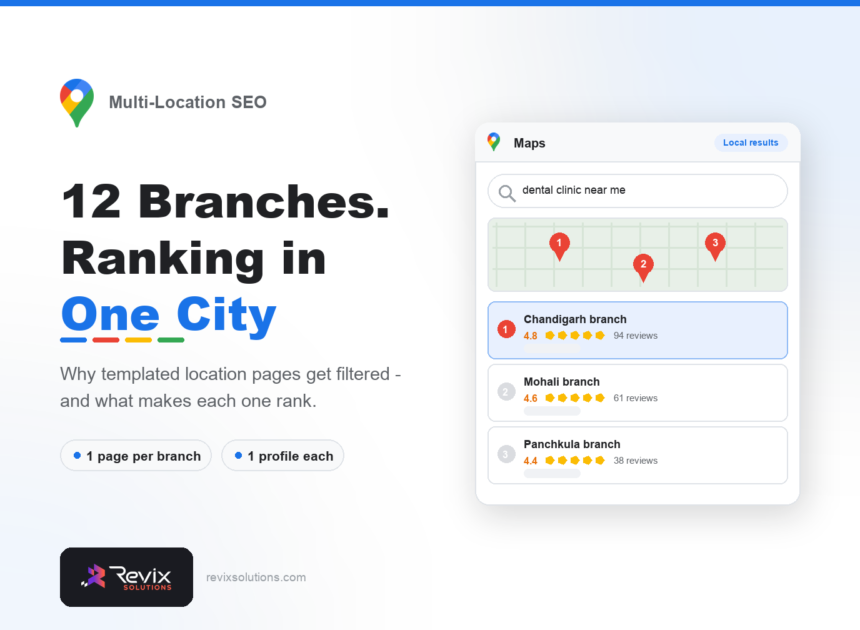
Multi-location SEO is the practice of ranking a business with several branches in local results for each area it serves.
Multi-location seo is the subject of this guide, so here is the short version first. Multi-location SEO fails for one predictable reason: the location pages are the same page with the city name swapped. Google filters near-duplicate pages, so a business with twelve branches ends up ranking in one town and nowhere else. This guide covers how to structure profiles, pages and reviews so every branch ranks in its own area — and how to scale that without it becoming unmanageable. A working multi-location SEO strategy gives every branch its own profile, its own page and its own reviews.
Multi-location seo: the short answer
Give every staffed branch its own verified Google Business Profile with a local phone number, and every branch its own landing page containing genuinely different content: real staff, real photographs, local directions, branch-specific services and that location reviews. Use a consistent URL pattern and link every page from a central locations hub. If you cannot write unique content for a location, do not publish a page for it.
Why most multi-location SEO fails
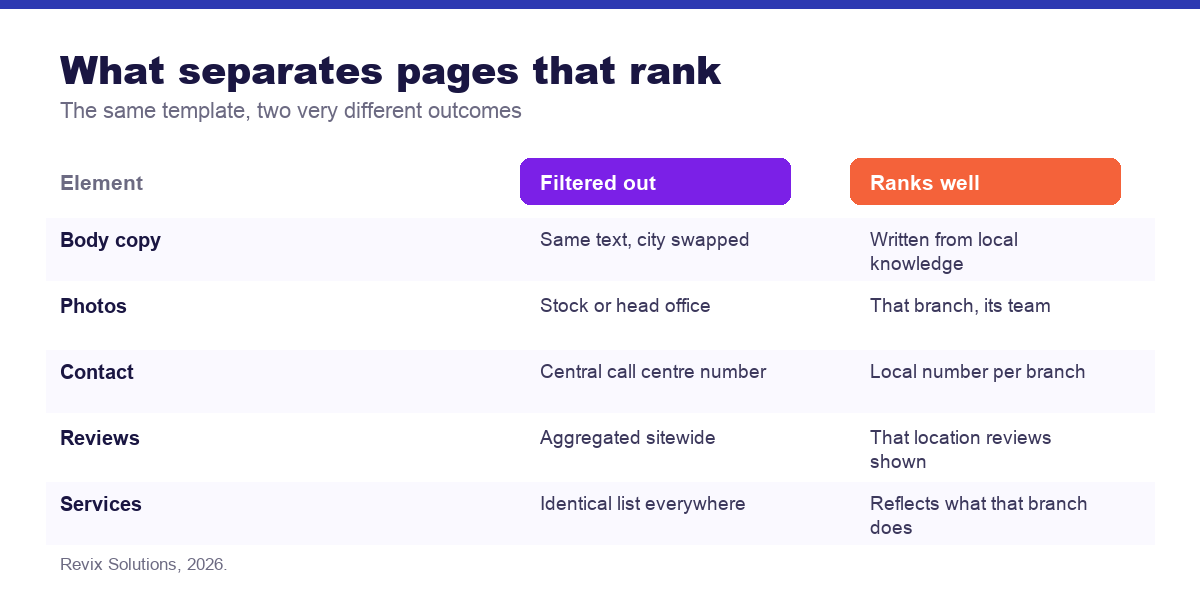
The template approach is seductive: build one page, duplicate it across forty cities, change the name. It is fast, it looks complete, and it does not work. Search engines detect near-duplicate pages and show at most one of them, which means thirty-nine pages of effort produce nothing.
The underlying issue is that a templated page contains no information a searcher could not get elsewhere. There is no reason for it to rank, because it answers nothing specific to that area.
One profile per staffed location
Google Business Profiles drive local visibility, and each genuine branch is entitled to one. The rules matter here because violations cause suspensions.
- Each location must be a real premises with staff during stated hours. Virtual offices and mailbox addresses cause suspensions.
- Use a local phone number per branch rather than a single central number, which weakens each location’s association with its area.
- Link each profile to its own landing page, never to the homepage. This is one of the most common and most costly mistakes.
- Set categories per location. Branches often differ in what they actually offer.
- Manage reviews per location. Reviews attach to profiles, not to your brand overall.
Location pages that are genuinely different
Each page needs content that could only have been written about that branch. In practice that means including these things.
| Include | Example | Why it matters |
|---|---|---|
| Named staff | Branch manager and team | Nothing is less duplicable than real people |
| Real photographs | That premises, inside and out | Proves the location exists |
| Local directions | Landmarks, parking, transport | Genuinely useful and unique |
| Branch-specific services | What this location actually does | Branches differ more than owners assume |
| Location reviews | Reviews from that branch customers | Fresh unique content plus trust |
| Local context | Areas served, typical customers | Signals genuine local operation |
The honest test
Read your location page and ask whether any sentence would be false if you changed the city name. If most of it would still be true anywhere, the page is a duplicate regardless of what the word count says.
URL structure and internal linking
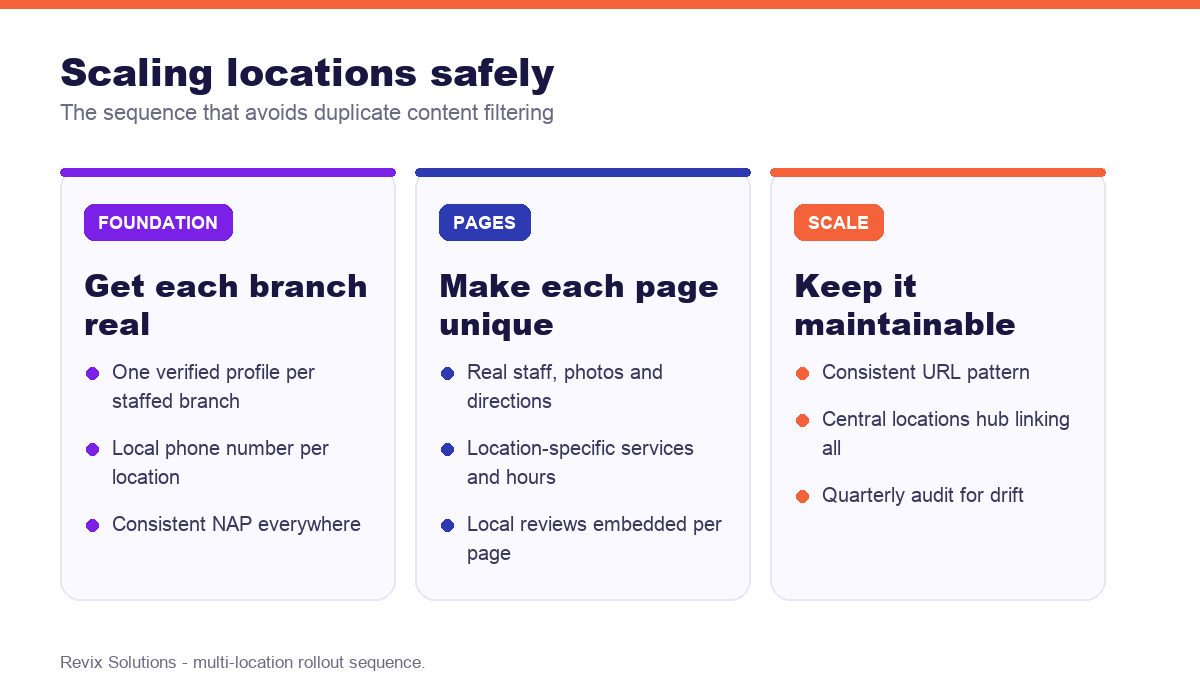
Choose one pattern and keep it. /locations/city-name/ is readable, scalable and shallow. Avoid nesting more than two levels deep, and never change the pattern once pages have accumulated rankings.
Build a central locations hub that links to every branch page, and link each branch page back to the hub. This ensures crawlers reach every location and distributes authority across them. Adding a few links between geographically related branches helps further.
Reviews at scale
Reviews are location-specific, which means a strong head office presence does nothing for a struggling branch. Build a request process each branch actually follows — asking at the point of service, sending the direct link the same day — and monitor per-location averages rather than a company-wide figure that hides problems.
Scaling without it collapsing
The practical constraint is maintenance. Forty pages with real content need real upkeep as staff, hours and services change. Two suggestions that make this survivable: build fewer, better pages rather than covering every postcode, and audit quarterly for pages that have drifted out of date, because a page listing a manager who left two years ago damages trust more than having no page.
Frequently asked questions
What is multi-location SEO?
In practice, multi location seo follows the same rules for most businesses. Multi-location SEO is the practice of ranking a business with several physical locations in local results for each area, using a separate Google Business Profile and a dedicated landing page per location.
Do I need a separate page for each location?
Yes. Each location needs its own page with a unique address, phone number, staff, hours and genuinely local content. A single contact page listing all branches cannot rank for each area.
Should each location have its own Google Business Profile?
Yes, provided each is a real staffed premises. Every profile needs its own verification, categories and reviews, and should link to that location’s specific landing page rather than the homepage.
How do I avoid duplicate content across location pages?
Write genuinely different content for each: local landmarks, staff names, area-specific services, local reviews and directions. Templated pages with only the city name swapped tend to be filtered from results.
Can multiple locations share one phone number?
It is better for each location to have its own local number, since consistent location-specific contact details strengthen the association between a profile and its area.
How do I structure URLs for multiple locations?
A consistent pattern such as /locations/city-name/ works well. Keep it shallow, readable and stable, and link every location page from a central locations hub.
If you would rather have multi location seo handled for you, our local SEO services and website optimisation cover exactly the work described above.
Every one of these mistakes is avoidable, and together they explain most of the gap between businesses that get results from multi location seo and those that do not.
Because of that, multi-location seo rewards consistency far more than intensity.
However, multi-location seo only compounds when the basics stay in place month after month.
In practice, most businesses underestimate how long multi-location seo takes to show results.
As a result, multi-location seo works best when it is measured against enquiries rather than rankings.
That said, multi-location seo is not a one-off project, and treating it as one is the usual mistake.
Multi location seo: what to do next
The short version of this guide: multi location seo rewards sequence over effort. Fix the foundations first, publish what your customers actually search for, then measure enquiries rather than rankings. Businesses that treat multi location seo as a system rather than a checklist are the ones still compounding a year later.
Ranking in one city but invisible in the rest?
We will audit your location profiles and pages, identify which are being filtered as duplicates, and give you a prioritised plan to get every branch ranking in its own area.
Get your free multi-location audit
Plans start from Rs 16,000 per month. See current pricing.
Related reading: Google Business Profile optimization guide, schema markup for local business.