
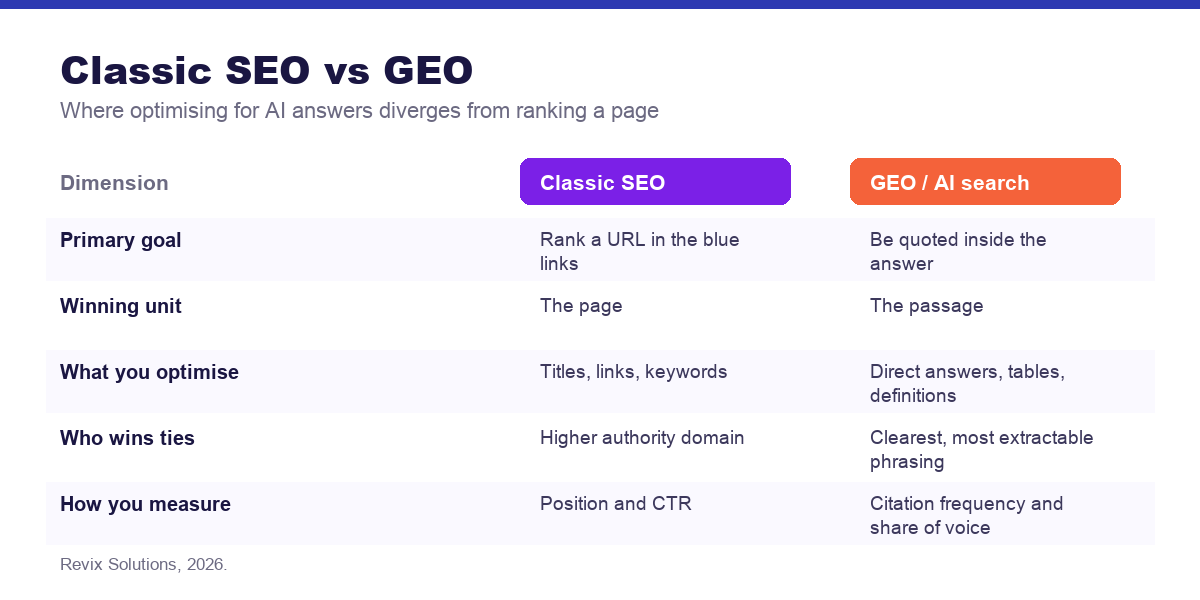
To rank in Google AI Overviews you need to be quoted, not just ranked. AI Overviews assemble an answer from passages across several pages, so the winning unit is no longer the page — it is the paragraph. This guide covers what the evidence currently shows about how sources get selected, the page structures that make extraction easy, and a twelve-point checklist you can apply to any article today. Understanding how to rank in Google AI Overviews starts with one shift: optimise the passage, not just the page.
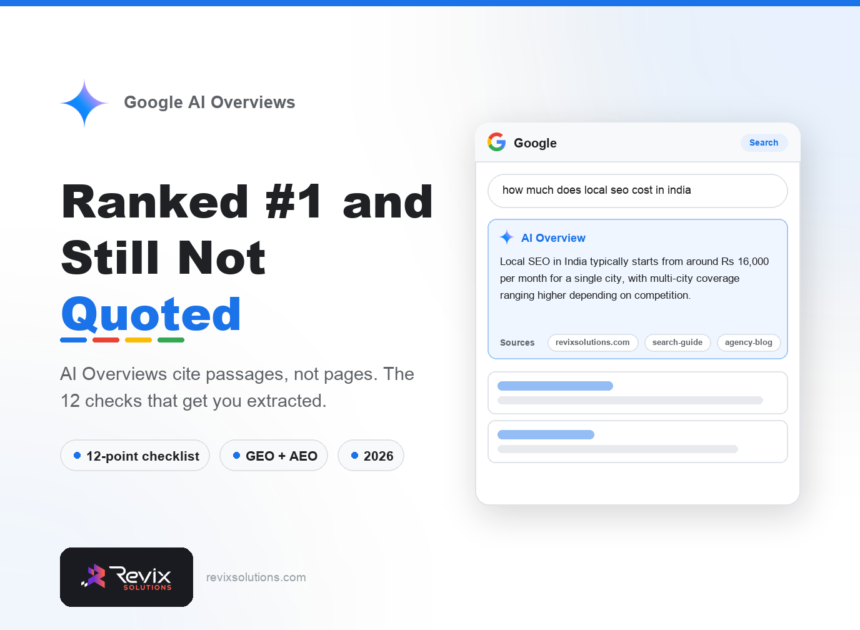
Ranking in Google AI Overviews means being quoted as a source inside the AI-generated summary that appears above the normal results.
The short answer
Pages cited in AI Overviews tend to share four traits: they answer the question directly in the first two sentences under a heading, they use the phrasing real people search with, they present facts in extractable formats such as tables and short definitions, and they already rank somewhere in the conventional top results for that query. You cannot buy placement, and there is no separate AI Overview ranking signal to game — but you can make your content dramatically easier to quote.
What are Google AI Overviews?
AI Overviews are AI-generated summaries that appear above the traditional search results for many queries. Google composes them by retrieving relevant passages from multiple web pages and synthesising an answer, with links to the sources it drew from.
The important mechanical detail is that the system retrieves passages, not whole documents. A 3,000-word guide might contribute a single 40-word sentence. That changes what optimisation means: your job is to make individual chunks of your page self-contained and quotable.
Why this changes the traffic equation
When an AI Overview answers a question completely, some users never click through. That is the widely reported downside. The upside is less discussed: being cited inside the answer puts your brand in front of a user at the exact moment of decision, often above competitors who rank higher in the blue links.
For a service business, the practical implication is to prioritise queries where the answer naturally leads to needing help. “What does local SEO cost” is worth being cited on. “What is a meta tag” is not — the answer is complete, and no follow-up is required.
How sources appear to be selected
Google has not published a ranking formula for AI Overview citations. What follows is drawn from Google’s own documentation on the topic and from consistent patterns observed across large-scale studies of cited URLs. Treat it as well-supported inference, not confirmed mechanics.
Conventional ranking still matters
Cited pages overwhelmingly already rank in the top results for the query or a close variant. AI Overviews are not a shortcut around SEO — they are a layer on top of it. If you are on page five, structural improvements alone will not get you cited.
Passage clarity matters more than page authority
Within the pool of pages that rank, the ones quoted tend to be those that state the answer plainly. A well-known brand that buries the answer in paragraph nine frequently loses the citation to a smaller site that answers in sentence one.
Query fan-out means you compete on sub-questions
Google decomposes a complex query into several sub-questions and retrieves for each. This means one Overview may cite five different sites, each answering a different facet. You do not need to be the best page overall — you need to own one facet completely.
The page structure that gets extracted
Answer directly beneath the heading
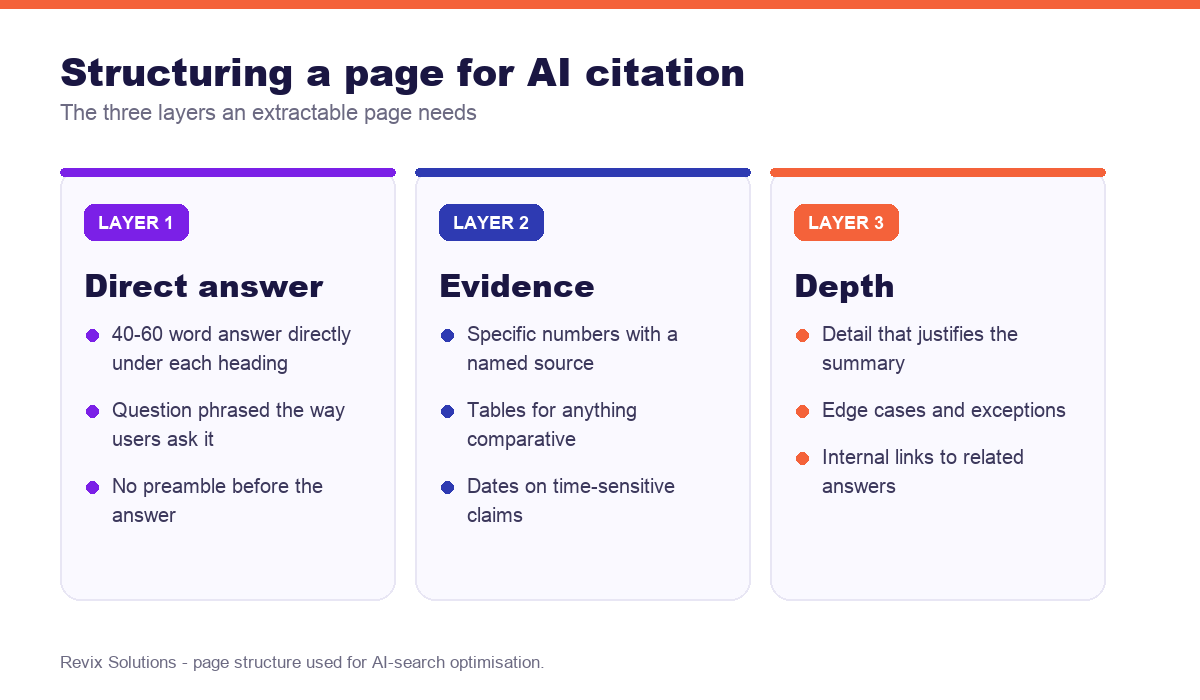
Make each H2 or H3 a question a real person would type, then answer it in 40–60 words immediately below. No throat-clearing, no “in today’s competitive landscape.” The first sentence should be extractable on its own.
Use the vocabulary of the query
If people search “how much does local SEO cost,” the heading should not read “Investment Considerations.” Match the language, then elaborate in your own voice.
Put comparative facts in tables
Tables are among the most reliably extracted structures on a page. Anything with a “versus,” a price range, or a set of options belongs in one.
Define terms explicitly
A sentence in the form “X is Y that does Z” is trivially quotable. Every article should define its central term once, cleanly, near the top.
Date and source your claims
Specific, attributed numbers are quoted far more often than vague assertions. “Most businesses” is unquotable; “typically three to six months, based on our engagements” is.
The 12-point AI Overview checklist
| # | Check | Why it matters |
|---|---|---|
| 1 | Page already ranks top 10 for the target query | Citation pool is drawn largely from ranking pages |
| 2 | Every heading is phrased as a real question | Matches how retrieval segments content |
| 3 | 40–60 word direct answer under each heading | The extractable unit |
| 4 | Central term defined in one clean sentence | Definitions are heavily quoted |
| 5 | At least one comparison table | Tables extract reliably |
| 6 | Numbers are specific and attributed | Vague claims are skipped |
| 7 | FAQ section with schema markup | Clean question-answer pairs |
| 8 | Content updated within 12 months | Freshness weighs on many queries |
| 9 | Author and expertise visible | Supports trust assessment |
| 10 | Page loads fast and renders server-side | Content hidden behind JavaScript may not be retrieved |
| 11 | Internal links to related sub-answers | Helps cover query fan-out |
| 12 | No critical content locked behind interaction | Accordions and tabs can hide text from extraction |
GEO, AEO and SEO: what the terms actually mean
The vocabulary has multiplied faster than the practice. Here is the honest distinction.
SEO optimises for ranking a page in a list of links. AEO (answer engine optimisation) targets direct-answer surfaces such as featured snippets and voice results. GEO (generative engine optimisation) targets inclusion in AI-generated answers across Google, ChatGPT, Perplexity and similar systems.
In practice the three overlap heavily. Roughly 80% of the work — technical health, genuine expertise, clear structure — serves all three. The remaining 20% is the passage-level formatting described above. Anyone selling GEO as a wholly separate discipline is overstating the difference.
How to measure whether it is working
This is the weakest part of the discipline today, and it is worth being blunt about that. Google Search Console does not currently report AI Overview citations as a separate dimension, so you cannot simply pull a report.
What you can do:
- Track impressions against clicks on informational queries. Rising impressions with falling CTR often indicates an Overview is absorbing the click.
- Manually sample your priority queries monthly. Record whether an Overview appears and whether you are cited. Tedious, but it is real data.
- Query the assistants directly. Ask ChatGPT and Perplexity your target questions and note who gets named.
- Watch branded search volume. Citation without clicks still drives recall, which shows up later as direct and branded search.
Mistakes that keep pages out of AI answers
- Burying the answer. Three hundred words of context before the actual answer makes extraction unlikely.
- Writing for word count. Padding dilutes the passages that would otherwise be quoted.
- Hiding content in tabs or accordions. If it requires a click to reveal, treat it as at risk.
- Unsourced statistics. Numbers without attribution are frequently skipped.
- Chasing queries you cannot rank for. Structure will not overcome a position-60 page. Fix rankings first.
Where to start this week
Do not rewrite your site. Take the five pages that already rank between positions 3 and 15 for questions with commercial relevance, and apply the checklist to those. They are in the citation pool already; small structural changes there produce the fastest return.
Frequently asked questions
Can you pay to appear in Google AI Overviews?
In practice, how to rank in google ai overviews follows the same rules for most businesses. No. Citations are drawn algorithmically from web content, and there is no paid placement into the organic Overview itself. Ads may appear near Overviews, but that is separate from being cited as a source.
Do AI Overviews reduce website traffic?
They can reduce clicks on purely informational queries where the answer is complete. Queries that require a decision, a quote or a service tend to retain their clicks, and citation adds brand visibility above the traditional results.
Does schema markup help with AI Overviews?
Schema does not guarantee citation, but FAQ and Article markup make the question-and-answer structure of a page explicit, which supports reliable extraction. It is worth implementing as part of good structure rather than as a shortcut.
How long does it take to get cited in AI Overviews?
For pages already ranking in the top ten, structural improvements can be reflected within a few weeks of recrawling. For pages not yet ranking, expect to solve the ranking problem first, which typically takes three to six months.
Is GEO different from SEO?
They overlap substantially. GEO adds passage-level formatting for extraction on top of conventional SEO foundations, but it does not replace technical health, authority or relevance.
Which content types get cited most often?
Definitions, comparison tables, step-by-step processes and direct answers to specific questions are cited disproportionately. Narrative-heavy content with no clear extractable statements is cited least.
If you would rather have how to rank in google ai overviews handled for you, our generative engine optimisation and answer engine optimisation cover exactly the work described above.
Every one of these mistakes is avoidable, and together they explain most of the gap between businesses that get results from how to rank in google ai overviews and those that do not.
Because of that, how to rank in google ai overviews rewards consistency far more than intensity.
However, how to rank in google ai overviews only compounds when the basics stay in place month after month.
In practice, most businesses underestimate how long how to rank in google ai overviews takes to show results.
As a result, how to rank in google ai overviews works best when it is measured against enquiries rather than rankings.
That said, how to rank in google ai overviews is not a one-off project, and treating it as one is the usual mistake.
How to rank in google ai overviews: what to do next
The short version of this guide: how to rank in google ai overviews rewards sequence over effort. Fix the foundations first, publish what your customers actually search for, then measure enquiries rather than rankings. Businesses that treat how to rank in google ai overviews as a system rather than a checklist are the ones still compounding a year later.
Want to know which of your pages are close to being cited?
We will review your top-ranking pages against the twelve-point checklist, identify which queries are already showing AI Overviews in your market, and show you the specific edits most likely to earn citations.
SEO and GEO retainers start from Rs 16,000 per month. See current pricing.
Related reading: The future of SEO with AI, the perfect SEO title tag formula, and how to outrank your competitors on Google India.