
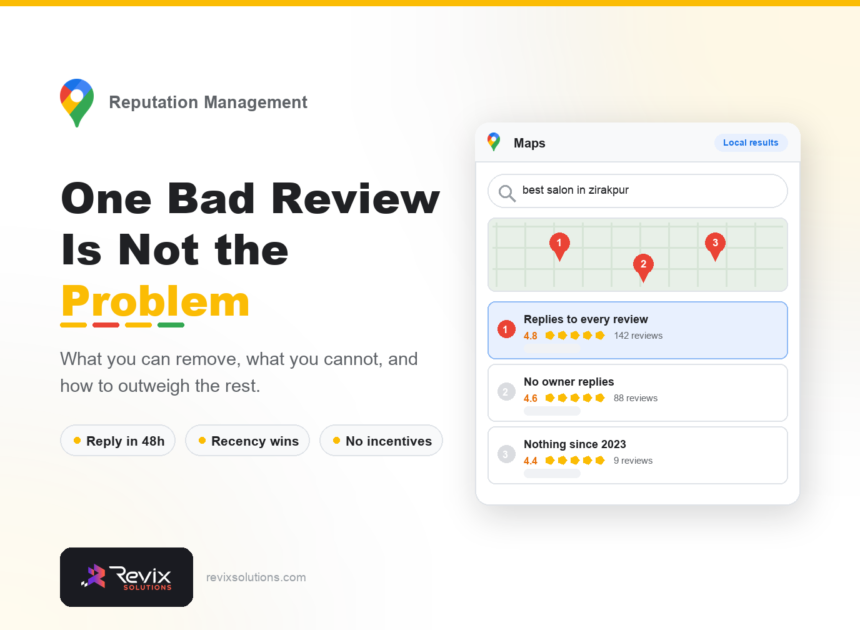
Most reputation problems are not caused by bad reviews — they are caused by silence around them. A single one-star review with no reply reads far worse than the same review with a calm, factual response beneath it. This guide covers what you can realistically remove, how to respond, and how to build enough recent positive feedback that one bad experience stops defining you. Practical online reputation management for local business is mostly process, not persuasion.
Online reputation management for a local business is the practice of monitoring and improving the reviews and search results people see before they call.
Online reputation management for local business: the short answer
You cannot remove a genuine negative review. You can remove reviews that breach platform policy – spam, conflict of interest, offensive content – by reporting them. For everything else the answer is the same: reply within 48 hours calmly and factually, then build a steady flow of recent reviews so the negative one becomes a small part of a larger picture.
What prospective customers actually look at
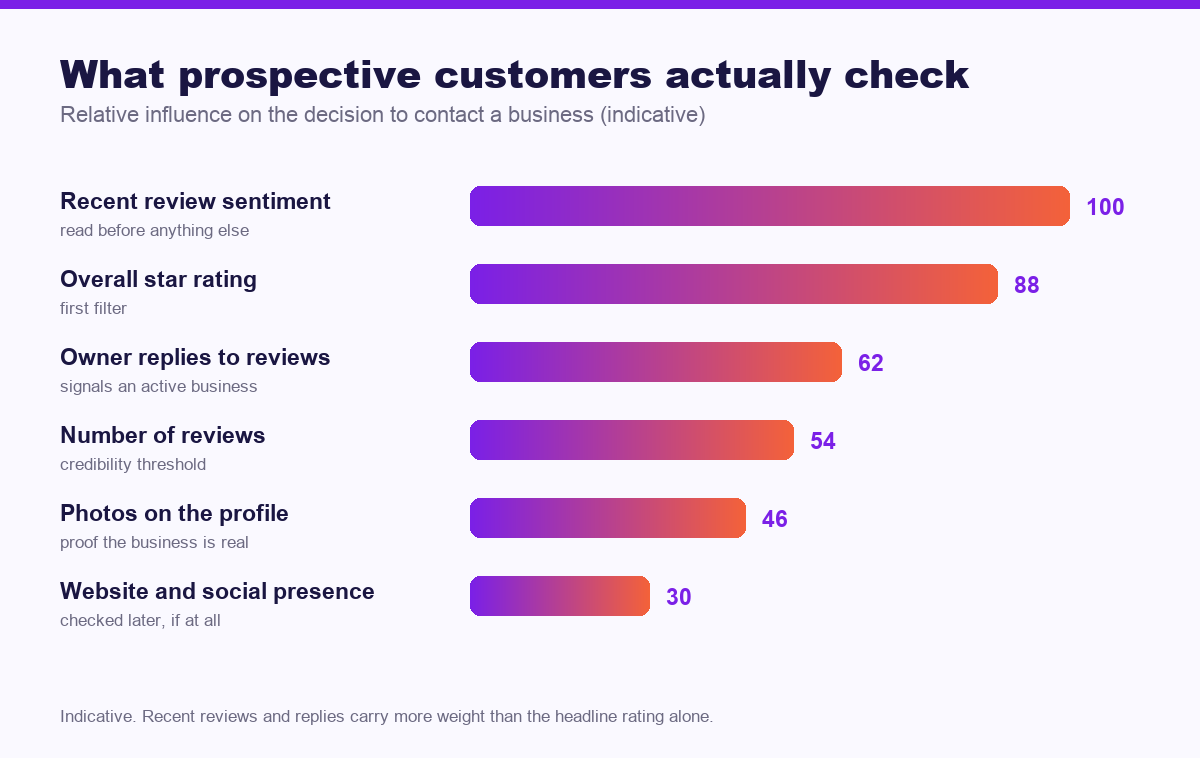
People do not read your website first. They look at your star rating, then read the two or three most recent reviews, then check whether you replied. That sequence takes about twenty seconds and decides whether they call you.
This has a useful implication: a business with a 4.3 rating, recent reviews and thoughtful replies frequently outperforms a 4.8 with nothing since 2023. Activity signals a functioning business.
What you can and cannot remove
| Situation | Removable? | What to do |
|---|---|---|
| Genuine bad experience | No | Reply well, resolve offline, build newer reviews |
| Review from a competitor | Sometimes | Report as conflict of interest with evidence |
| Obvious spam or bot review | Usually | Report through the platform |
| Offensive or personal content | Usually | Report as policy violation |
| Review for the wrong business | Usually | Report as not relevant |
| Factually false claim | Rarely | Reply with the facts, calmly and publicly |
Be realistic about removal
Services promising to delete negative reviews are usually either reporting them exactly as you could yourself, or using methods that risk your profile. There is no legitimate paid route to removing a genuine review.
How to respond to criticism
Your reply is not written for the reviewer. It is written for the next fifty people who read it while deciding whether to contact you.
- Reply within 48 hours. Speed signals that you care and limits how long the review sits unanswered.
- Stay calm regardless of accuracy. An aggressive reply damages you far more than the original review.
- Acknowledge before explaining. “I am sorry your installation was delayed” before the reason.
- Keep details offline. Offer a direct contact rather than debating specifics publicly — essential in healthcare and any field with confidentiality obligations.
- Do not deny without evidence. If you genuinely have no record of the customer, say so neutrally and invite them to make contact.
Reply to positive reviews too
Short, specific replies to good reviews take seconds, show the profile is active, and make your responses to criticism look like normal practice rather than damage control.
Building review flow
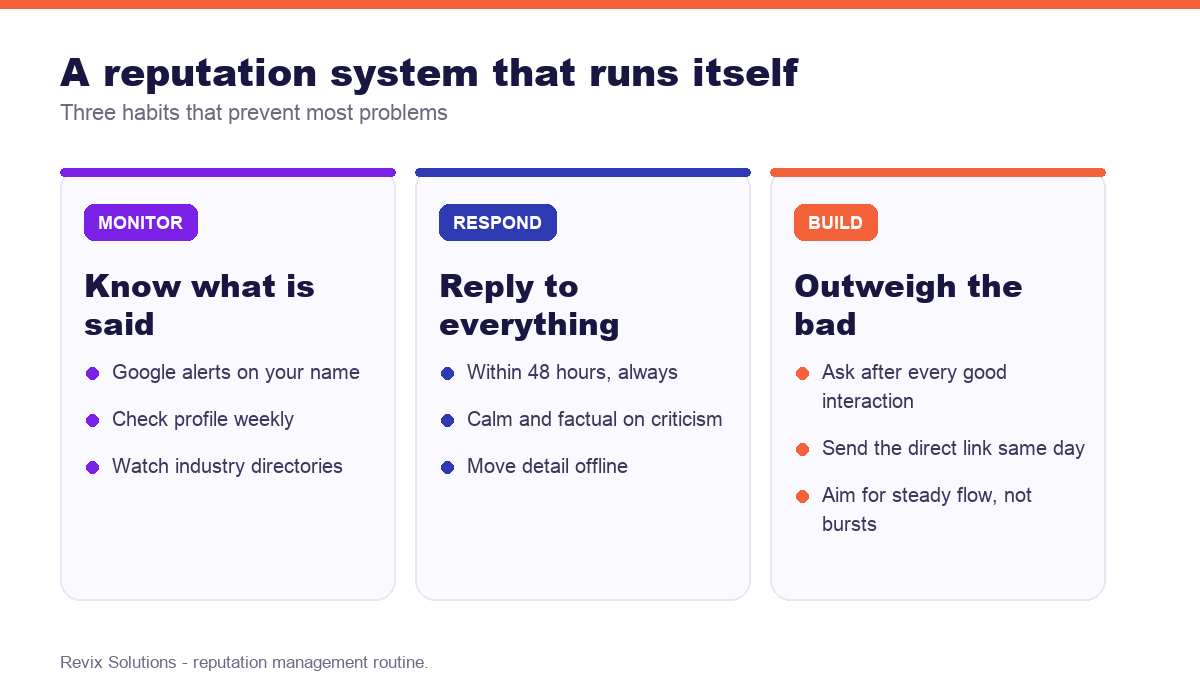
The most reliable protection is volume of recent positive feedback. Ask at the point of satisfaction — job completed, problem solved, order delivered — and send the direct review link by WhatsApp the same day. Generic requests a week later convert poorly.
Aim for steady flow rather than bursts. Four genuine reviews a month sustained across a year builds far more credibility than forty in one week, which looks manipulated to both platforms and readers. Never offer incentives; it breaches Google’s policies and can cost you the profile.
Monitoring without it becoming a job
Set a Google Alert for your business name, check your Google Business Profile weekly, and review the main directories in your industry monthly. That is sufficient for most local businesses. Anything more elaborate is usually a service being sold rather than a need being met.
Reputation beyond reviews
Search your business name and see what fills the first page. Ideally it is your website, your Google profile, your social accounts and positive coverage. If something unwanted appears, the practical response is usually to publish and strengthen assets you control — a well-optimised profile, active social pages, useful content — so they occupy the results instead.
Frequently asked questions
What is online reputation management?
In practice, online reputation management for local business follows the same rules for most businesses. Online reputation management is the practice of monitoring and improving what appears about your business online – reviews, search results and social mentions – so prospective customers find an accurate picture.
Can I remove a negative Google review?
Only if it breaches Google’s policies, such as spam, conflict of interest or offensive content. A genuine negative experience cannot be removed, and the effective response is a good public reply plus more recent positive reviews.
How should I respond to a negative review?
Reply promptly, calmly and factually. Acknowledge the issue, avoid disputing details publicly, and offer to resolve it offline. Prospective customers read the reply more carefully than the complaint.
Do negative reviews hurt local rankings?
Review rating is one factor among several, so a few negative reviews rarely move rankings much. The larger effect is on whether people choose you once they see you.
How many reviews should a business aim for?
Enough to be competitive with businesses currently ranking in your area, with a steady flow of recent ones. Recency signals an active business more effectively than a large stale total.
Is it legal to offer incentives for reviews?
Offering incentives for reviews breaches Google’s policies and can result in review removal or profile suspension. Asking customers for honest feedback is fine; paying for ratings is not.
If you would rather have online reputation management for local business handled for you, our local SEO services and our SEO company cover exactly the work described above.
Online reputation management for local business: what to do next
The short version of this guide: online reputation management for local business rewards sequence over effort. Fix the foundations first, publish what your customers actually search for, then measure enquiries rather than rankings. Businesses that treat online reputation management for local business as a system rather than a checklist are the ones still compounding a year later.
One bad review costing you customers?
We will audit what appears when someone searches your business, review how your profile compares with local competitors, and build you a review process that produces a steady flow.
Get your free reputation review
Plans start from Rs 16,000 per month. See current pricing.
Related reading: Google Business Profile optimization guide, local citations in India.