
Most service businesses publish content nobody searches for. Industry news, company updates and generic advice generate neither traffic nor enquiries, which is why so many businesses conclude content marketing does not work for them. The content that does work is narrower and less glamorous: answering the specific questions people ask immediately before they buy. Content marketing for service businesses works when it answers the questions asked immediately before buying.
Content marketing for service businesses is publishing material that answers the questions prospects ask immediately before they buy.
Content marketing for service businesses: the short answer
Write about cost, comparisons, process and diagnosis – the four things prospects research before choosing a supplier. Two to four pieces a month sustained for a year outperforms any burst of activity. Measure enquiries by landing page rather than traffic, because a page with 200 visits and three enquiries is worth more than one with 5,000 visits and none.
The four topics that produce enquiries
Cost and pricing
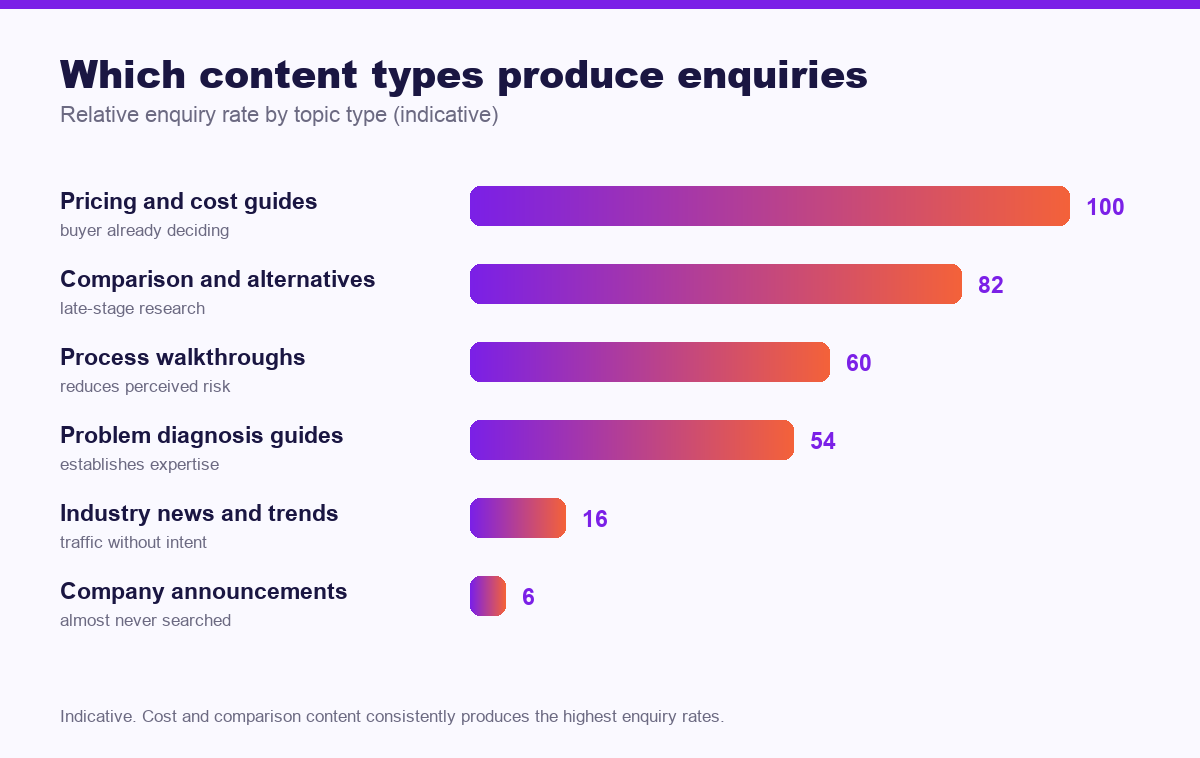
The most searched and most avoided topic in every service industry. Someone searching “what does X cost” has decided they need X and is choosing a supplier. Publishing honest ranges with an explanation of what moves the price attracts these people and filters out those who were never going to pay properly.
Comparisons and alternatives
“X versus Y,” “alternatives to X,” “is X worth it.” These searches happen at the decision point. Writing them fairly — including where your option is the wrong choice — builds more trust than a one-sided pitch, and reliably converts better.
Process walkthroughs
People hesitate because they do not know what happens after they call. Describing your process step by step, with timelines, removes that friction and reads as confidence.
Diagnosis and troubleshooting
“Why is my X doing Y.” These attract people with an active problem. Some will fix it themselves, which is fine — the ones who cannot will call the business that explained it clearly.
What consistently does not work
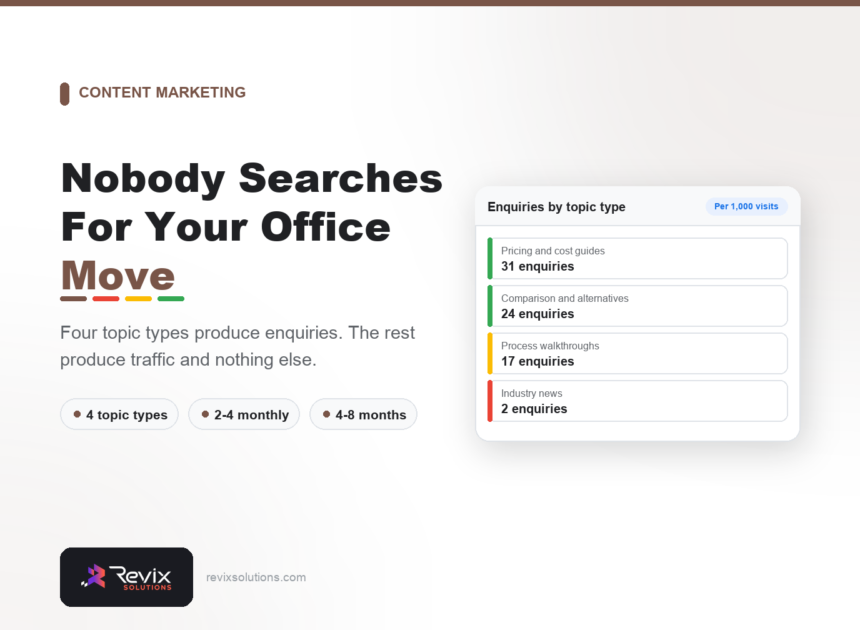
- Company news. Nobody searches for your office move.
- Generic industry trends. High competition, no buying intent, no differentiation.
- Content written for word count. Padding dilutes the passages that would otherwise rank or be cited.
- Topics with no connection to what you sell. Traffic that cannot convert is a cost, not an asset.
Where topics actually come from
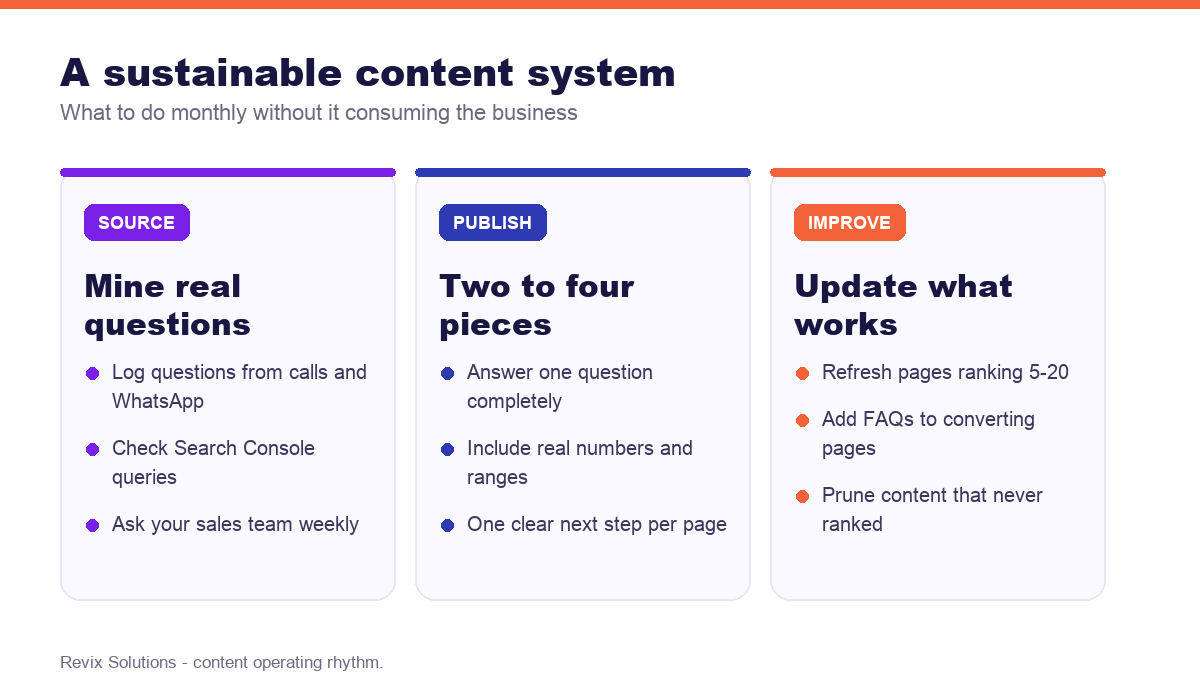
The best source is not a keyword tool — it is your own phone. Every question a prospect asks before buying is a topic someone else is typing into Google right now.
Keep a running log of questions from calls, WhatsApp and email for one month. You will have a year of content ideas, all validated by real demand. Supplement this with Search Console queries where you appear but rank poorly, since those represent demand you are already partly visible for.
A realistic publishing rhythm
| Business size | Realistic cadence | Focus |
|---|---|---|
| Solo / very small | 1–2 pieces a month | Cost and process pages only |
| Small team | 2–4 pieces a month | Add comparisons and diagnosis |
| Established firm | 4–8 pieces a month | Full coverage plus updating older pages |
Updating beats publishing
Once you have thirty or forty pages, improving pages that rank between positions five and twenty produces faster returns than writing new ones. They already have visibility; small improvements move them into clicking distance.
Measuring properly
Traffic is a vanity metric for a service business. Track enquiries attributed to landing pages, and cost per enquiry if you are paying for content. Expect four to eight months before content contributes meaningfully — anything faster is usually a page that was already close to ranking.
Frequently asked questions
What is content marketing for a service business?
In practice, content marketing for service businesses follows the same rules for most businesses. It is publishing useful material that answers the questions prospects ask before they buy, so your business is found and trusted during research rather than only at the point of enquiry.
How often should a service business publish?
Two to four genuinely useful pieces a month sustained for a year beats twenty in one month followed by silence. Consistency matters more than volume.
How long before content marketing produces leads?
Expect four to eight months before content contributes meaningful enquiries. Pages targeting cost and comparison questions usually convert first.
What content converts best for service businesses?
Pricing explanations, comparison guides, process walkthroughs and honest answers about what a service does not solve. These attract people already deciding.
Should I write content myself or outsource it?
Write from your own expertise where possible, even roughly, then have it edited. Outsourced content written without domain knowledge reads generically and rarely converts.
How do I know if content marketing is working?
Track organic enquiries by landing page rather than traffic. A page with 200 visits producing three enquiries beats one with 5,000 visits producing none.
If you would rather have content marketing for service businesses handled for you, our content writing services and guest posting services cover exactly the work described above.
Content marketing for service businesses: what to do next
The short version of this guide: content marketing for service businesses rewards sequence over effort. Fix the foundations first, publish what your customers actually search for, then measure enquiries rather than rankings. Businesses that treat content marketing for service businesses as a system rather than a checklist are the ones still compounding a year later.
Publishing content but not getting enquiries?
We will review your existing content against what your customers actually search for, identify which pages are closest to producing leads, and give you a topic plan built from real demand.
Plans start from Rs 16,000 per month. See current pricing.
Related reading: how to rank in Google AI Overviews, keyword research for Indian businesses.