
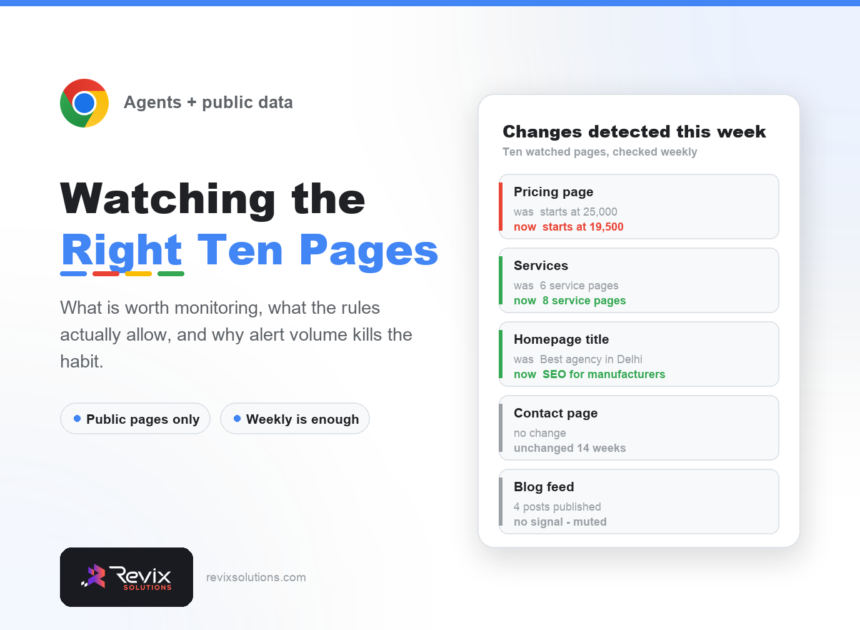
Competitor monitoring with ai agents means watching a small number of public pages for meaningful change – not scraping an entire sector. Done narrowly it tells you what a rival decided before their rankings move. Done broadly it produces an alert feed nobody opens after week three.
The short answer
Monitor public pages only, respect robots.txt, and keep request rates low. Watch pricing pages, new service pages and title rewrites – these signal strategy. Skip full blog feeds, which generate volume without insight. Weekly checks on ten pages beat daily checks on hundreds, because the second setup gets ignored.
Where competitor monitoring with ai agents stays within the rules
Reading publicly accessible pages at a modest rate is normal web behaviour. Bypassing logins, paywalls or access controls is not, and neither is hammering a server. Respect robots.txt and keep the frequency low – both are simple and both keep you clearly on the right side.
| Activity | Acceptable | Why |
|---|---|---|
| Reading public service pages | Yes | Ordinary browsing |
| Respecting robots.txt | Required | Stated site preference |
| Low request rate | Required | Avoids burdening the server |
| Bypassing a paywall | No | Circumvents access control |
| Scraping behind a login | No | Breaches terms of service |
What is actually worth watching
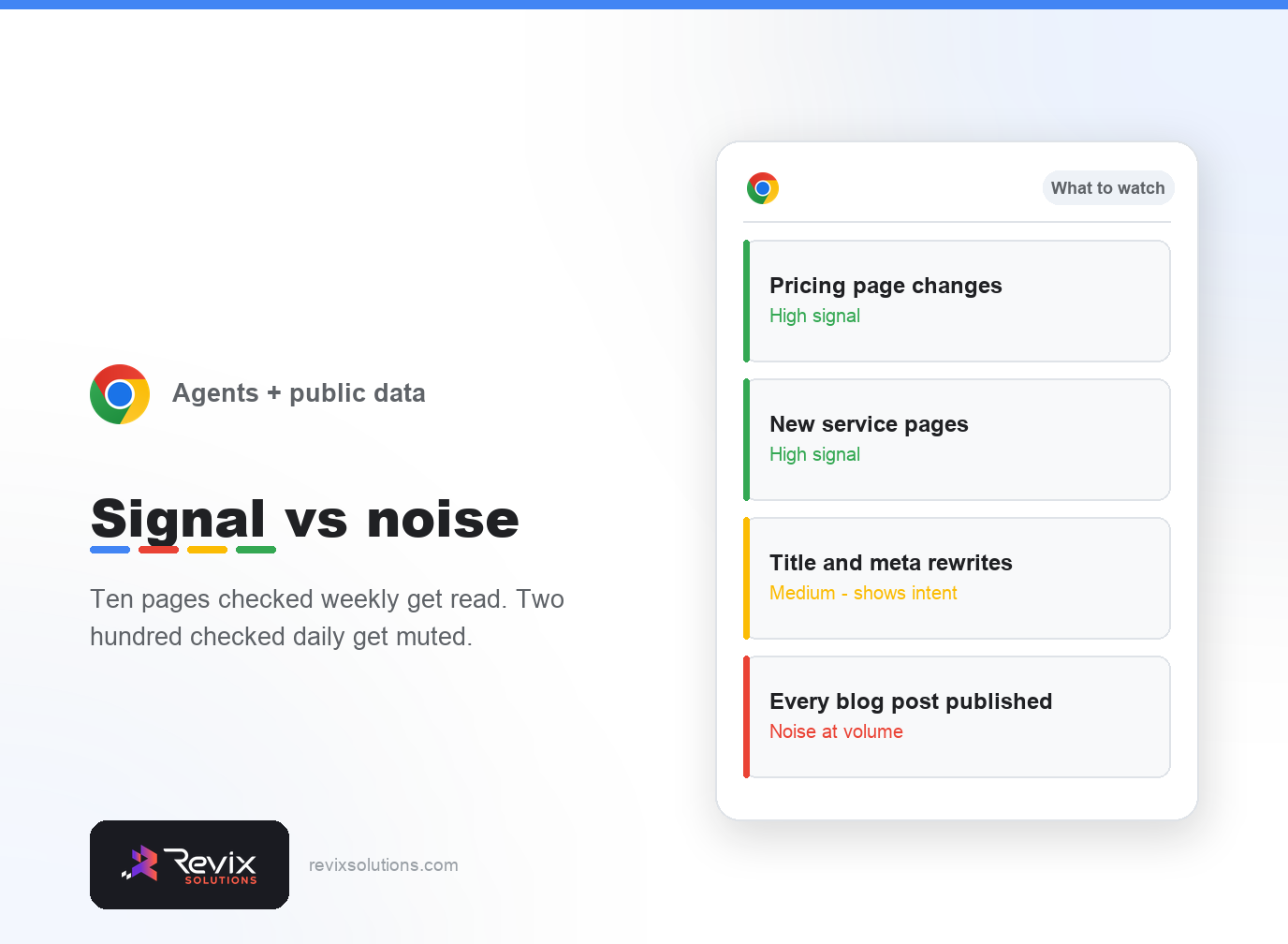
Pricing and service pages change rarely, so a change means a decision. Blog output changes constantly, so it means very little on its own.
In practice, competitor monitoring with ai agents rewards small scoped changes over sweeping ones.
However, competitor monitoring with ai agents only pays off when every change is reviewed before it ships.
That said, competitor monitoring with ai agents does not remove the need for someone who understands the business.
Using what you find
A competitor change is evidence of intent, not evidence of success. Copying a price cut without knowing whether it worked is how you fund their experiment. Note the change, wait for the outcome, then decide.
Frequently asked questions
Can I legally monitor competitor pages?
Reading public pages is generally fine. Respect robots.txt, keep request rates low, and do not bypass access controls or paywalls.
What is worth monitoring?
Pricing pages, service pages, new content and title or meta changes. These signal strategy shifts before rankings move.
How often should checks run?
Weekly for most markets. Daily only where pricing genuinely moves that fast.
What do I do with the alerts?
Treat them as context, not instructions. Copying a competitor’s change without knowing whether it worked for them is guesswork.
Does this replace rank tracking?
No. Rank tracking tells you the outcome; change monitoring tells you what someone did that might explain it.
What usually goes wrong?
Alert volume. Monitor ten pages that matter rather than every page a competitor has.
If you would rather have competitor monitoring with ai agents handled for you, our SEO services and free SEO audit cover exactly this work.
Want to know where you actually stand?
We benchmark your visibility against the competitors who genuinely take your enquiries, and show you the gaps worth closing.
Plans start from Rs 16,000 per month. See current pricing.
Related reading: keyword research for Indian businesses, Google Search Console for beginners.